Radians and Angular Motion
Radians as natural angular measure for circular motion, harmonic oscillations, and rotational physics.
What it is
This leaf studies how to understand the radian as arc divided by radius and use it in rotation, oscillations, and circular motion. Trigonometry is not a list of calculator buttons: it is the language connecting angle, direction, length, component, sign, and scale. A student starting from scratch must first learn that every angle needs a reference; then that trigonometric ratios turn geometry into calculation; finally that this structure reads physical problems involving forces, velocities, fields, slopes, and rotations.
The central idea is that a direction is not understood by a number alone. One must know from which axis it is measured, which sense is positive, which quadrant it lies in, and which quantities are projected onto the axes. This leaf therefore moves from basic recognition to advanced use: identify the drawing, calculate, interpret signs, and decide whether the geometric model represents the real system.
Why it appears in physics
It appears because many physical quantities have direction or depend on geometry. In kinematics, positions and velocities are projected; in dynamics, forces are decomposed; in energy, slopes and distances are read; in electricity and magnetism, fields are described; in waves and rotation, angles change with time.
Physical use requires preserving unit, sign, domain, and model. A force component is still measured in newtons, angular velocity requires coherent angle units, and a projected distance cannot exceed the original magnitude unless a ratio has been inverted incorrectly. Trigonometry is the bridge between drawing and equation.
Visual or geometric idea
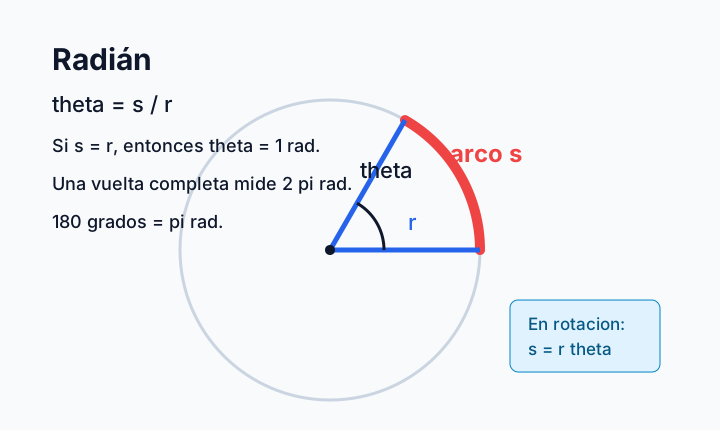
Visually, the problem reduces to locating a triangle, an arc, a direction, or a projection. The hypotenuse often represents the magnitude of a quantity; the legs represent components or measurable distances; the angle decides which part falls on each axis. If the reference axis changes, sine and cosine may swap, and if the quadrant changes, signs change.
| Measure | Relation | Physical use |
|---|---|---|
| 1 rad | arc = radius | natural rotation angle |
| pi rad | 180 degrees | half turn |
| 2 pi rad | 360 degrees | full turn |
| theta rad | s = r theta | arc length |
Minimal symbolic language
The reference symbolic expression is theta = s/r, s = r theta, omega = Delta theta / Delta t. It must not be memorized in isolation: it must be read together with the drawing. Each symbol represents a quantity with unit or a dimensionless ratio. Angles may be written in degrees to interpret a drawing, but in advanced calculation and angular motion radians are the natural measure.
Basic level: identify leg, hypotenuse, radius, arc, axis, or component. Intermediate level: choose sine, cosine, tangent, Pythagoras, or polar conversion depending on the missing data. Advanced level: check quadrant, inverse-function domain, physical sign, result scale, and model conditions.
What the result means
The result is not just a number. It means a projected length, direction, component, inclination, position, or angular scale. It must have a unit if it represents a physical quantity and must be dimensionless if it represents a trigonometric ratio. If the result contradicts the drawing, expected sign, or order of magnitude, the calculation is not finished.
It also means a dependence. If the angle moves toward a more horizontal direction, a horizontal component usually grows and a vertical one decreases. If the radius increases at the same angle, coordinates grow proportionally. This dependence reading is what allows new physics problems to be attacked.
When not to use it
Do not apply trigonometry mechanically if axis, angular reference, positive sense, and domain have not been fixed. Do not use a right triangle when the real geometry does not contain one, and do not take an inverse function without checking that several angles may have the same ratio.
At advanced level, do not extrapolate a plane drawing to a three-dimensional, curved, or variable system without justifying the model. If the angle changes with time, the radius is not constant, or components depend on a moving basis, the tool remains useful but requires more care.
Operational summary
First draw or identify the geometry. Then fix reference, axis, positive sense, and angular unit. Next choose the appropriate relation, calculate with units, and check sign, quadrant, domain, and scale. Always close with a physical sentence: what was obtained, in what unit, under what geometry, and what error was avoided.
Procedure
Before calculating
Read the statement and decide which geometry appears: right triangle, circular arc, inclined axis, vector direction, or polar coordinates. Before calculating, write the target quantity, expected unit, and angle being used. If the angle has no reference, the problem is not defined yet.
Make a simple drawing. Mark adjacent leg, opposite leg, hypotenuse, radius, arc, horizontal axis, vertical axis, and positive sense when needed. This preparation prevents choosing sine or cosine by memory alone.
Step 1: identify the mathematical object
The object may be a trigonometric ratio, a projection, a coordinate conversion, an arc length, a similarity relation, or Pythagoras. In this leaf the main tool is to understand the radian as arc divided by radius and use it in rotation, oscillations, and circular motion.
Classify the difficulty: basic if only one side is missing; intermediate if a function or unit conversion must be chosen; advanced if quadrants, signs, inverse functions, radians, or a moving basis appear.
Step 2: choose the operation
Choose the operation from the geometry. If you have hypotenuse and need the horizontal component from the x-axis, use cosine. If you need the vertical component, use sine. If you have slope between two legs, use tangent. If radius and arc appear, use radians. If radial position appears, convert between polar and Cartesian coordinates.
Do not substitute numbers until the symbolic relation is clear. For this leaf, a guide form is theta = s/r, s = r theta, omega = Delta theta / Delta t. Then adapt signs and units to the physical system.
Step 3: preserve units and signs
Trigonometric ratios have no unit, but lengths, forces, velocities, fields, and radii keep their units. A component of 50 N remains in newtons; a position remains in meters; an angular velocity may be in rad/s.
The sign comes from the chosen axis and quadrant. Do not erase it by taking absolute values without justification. In physics, sign may indicate upward or downward, forward or backward, with or against a direction.
Step 4: calculate
Calculate visibly. First convert degrees or radians if needed. Then evaluate sine, cosine, tangent, root, or quotient. Watch for impossible results: sine greater than 1, component larger than magnitude without geometric reason, or negative distance where only length exists.
For estimation, use notable values: 30, 45, and 60 degrees. Knowing that sin(30)=1/2, sin(45)=sqrt(2)/2, and sin(60)=sqrt(3)/2 helps detect calculator or angle-mode errors.
Step 5: interpret the result
Write a complete physical sentence: horizontal force component, ramp height, arc traveled by a wheel, or Cartesian position of a polar point. State unit, sign, angular reference, and whether the scale is reasonable.
Advanced interpretation compares dependence: what happens if the angle increases, the radius changes, the axis is reversed, or another quadrant is used. If you cannot answer, the calculation is not yet understood.
Self-check checklist
Check: clear drawing, angular reference, positive sense, angular unit, chosen function, final units, sign, quadrant, domain, and scale. Decide whether the result can be compared with the original magnitude or a simple estimate.
Before finishing, state which error was avoided: confusing opposite and adjacent, mixing degrees and radians, forgetting quadrant sign, using the wrong triangle, or interpreting a dimensionless ratio as a physical quantity.
Guided example
Physical situation
Consider una rueda de radio 0.40 m que gira 3 rad in a physics problem where one needs to understand the radian as arc divided by radius and use it in rotation, oscillations, and circular motion. The goal is not to press a trigonometric function at random, but to translate the situation into clear geometry. First decide what the angle represents, from which axis it is measured, and which quantity must be calculated.
At basic level, recognizing the drawing and expected unit is enough. At intermediate level, the correct relation is chosen. At advanced level, signs, quadrants, domain, and scale are checked.
Mathematical translation
The translation uses the relation theta = s/r, s = r theta, omega = Delta theta / Delta t. The known datum is placed in its geometric role: magnitude, radius, hypotenuse, leg, arc, component, or coordinate. If the angle is measured from another axis, the function used may change.
The translation must preserve unit. A length remains in meters, a force remains in newtons, and a trigonometric ratio has no unit. This separation prevents mixing physical result with geometric factor.
Step-by-step calculation
Step 1: draw the geometry and mark the angle. Step 2: write the symbolic relation before substitution. Step 3: convert degrees or radians if needed. Step 4: calculate the value. Step 5: compare whether the result is smaller, larger, or compatible with the original magnitude.
If the calculation produces a component, its magnitude should not exceed the original magnitude. If it produces an angle, it must belong to the problem domain. If it produces a distance, it must have length unit.
Reading the result
The result is read as a physical statement: a component, direction, height, arc, position, or scale. Writing the number is not enough; one must state what it measures, relative to which reference, and with what sign.
Advanced reading compares dependencies. If angle, radius, or hypotenuse increases, the result should change as the model predicts. That comparison detects errors before an exam or a laboratory measurement.
Common error avoided
The avoided error is choosing the function by memory, mixing degrees and radians, forgetting the quadrant, or interpreting a dimensionless ratio as a magnitude. The method forces drawing, formula, and physical sentence to match.
Inverse example
Given result
Suppose an expression such as theta = s/r, s = r theta, omega = Delta theta / Delta t appears already written in a solution. The inverse question is: what geometry must have existed for that expression to be reasonable?
What physical question it can answer
It reconstructs whether the problem was asking for a component, an angle, a distance, a position, or an arc length. This inverse reading is important in advanced problems because one often reviews someone else's solution or debugs a simulation.
Common errors
Error 1: choosing the wrong operation
The most common error is choosing sine, cosine, tangent, Pythagoras, or polar conversion from memory rather than geometry. At basic level it is corrected by drawing opposite leg, adjacent leg, and hypotenuse. At intermediate level one checks which data are known and which are missing. At advanced level one checks whether the angle is measured from the correct axis.
If the result does not change as the drawing predicts, the operation was probably not appropriate. A horizontal component measured from the x-axis should be largest near zero degrees and small near ninety degrees.
Error 2: losing the meaning of the variable
A letter may represent magnitude, component, radius, arc, height, distance, or dimensionless ratio. If the same letter is used without physical meaning, the calculation becomes decorative. The variable must keep unit, sign, and role within the model.
In Radians and angular motion, losing meaning often leads to interpreting a trigonometric ratio as a length or a length as an angle. The control is to write a sentence: what does this variable measure and in what unit?
Error 3: ignoring units
Angles in degrees and radians are not interchangeable without conversion. In angular motion, using degrees inside formulas such as s = r theta breaks the scale because that relation requires radians. Components keep the unit of the original quantity.
Another error is failing to distinguish a dimensionless ratio from a physical quantity. sin(theta) is not measured in meters or newtons; it multiplies a length, force, or velocity to produce a component.
Error 4: confusing sign and magnitude
Magnitude is non-negative, but a component may be positive or negative depending on the axis. Erasing the sign may hide a force pointing downward, a velocity to the left, or a field in the opposite sense.
The sign also depends on quadrant. Two angles may have the same sine and different cosine, or the same tangent and opposite directions. The calculator does not replace geometric reading.
Error 5: applying a rule outside its domain
An inverse function only answers within a domain and may hide alternative solutions. If sin(theta)=0.5, the angle is not necessarily only 30 degrees; it may also be 150 degrees if the context allows it.
In physics problems, domain includes restrictions: positive radii, positive lengths, angles inside the motion interval, components compatible with magnitude, and valid plane models.
Quick detection rule
Before accepting the result, ask whether drawing, unit, sign, scale, and model all match. If an answer fails any of those five controls, it is not fixed by rounding; return to the geometric setup.
Physical applications
1. Kinematics
Physical context: motion with position, velocity, or trajectory. Operational use: calculate displacement or velocity components, estimate scale, and compare whether the sign matches the chosen axis. In this context, radians and angular motion connects the drawing with a measurable quantity and avoids using a formula without geometry.
The important transfer is that unit, sign, scale, and model must survive the calculation. If the component, distance, angle, or ratio obtained contradicts the physical system, the angular reference, quadrant, and chosen relation are reviewed before trusting the number.
2. Dynamics
Physical context: forces applied at an angle, inclined plane, or string. Operational use: calculate force components, detect the dominant term, and decide whether equilibrium or acceleration model is coherent. In this context, radians and angular motion connects the drawing with a measurable quantity and avoids using a formula without geometry.
The important transfer is that unit, sign, scale, and model must survive the calculation. If the component, distance, angle, or ratio obtained contradicts the physical system, the angular reference, quadrant, and chosen relation are reviewed before trusting the number.
3. Energy and work
Physical context: work by an oblique force or motion along a ramp. Operational use: interpret the projection parallel to displacement and compare whether the sign means energy input or loss. In this context, radians and angular motion connects the drawing with a measurable quantity and avoids using a formula without geometry.
The important transfer is that unit, sign, scale, and model must survive the calculation. If the component, distance, angle, or ratio obtained contradicts the physical system, the angular reference, quadrant, and chosen relation are reviewed before trusting the number.
4. Electricity, fields, and waves
Physical context: field, phase, propagation direction, or periodic signal. Operational use: calculate projections, phase, or angular relation and detect whether unit and domain are correct. In this context, radians and angular motion connects the drawing with a measurable quantity and avoids using a formula without geometry.
The important transfer is that unit, sign, scale, and model must survive the calculation. If the component, distance, angle, or ratio obtained contradicts the physical system, the angular reference, quadrant, and chosen relation are reviewed before trusting the number.
5. Laboratory and modeling
Physical context: indirect measurement of heights, distances, radii, or angles. Operational use: estimate geometric uncertainty, compare order of magnitude, and interpret whether the plane model is valid. In this context, radians and angular motion connects the drawing with a measurable quantity and avoids using a formula without geometry.
The important transfer is that unit, sign, scale, and model must survive the calculation. If the component, distance, angle, or ratio obtained contradicts the physical system, the angular reference, quadrant, and chosen relation are reviewed before trusting the number.
Practice
Level 1: recognition
Identify in a drawing the angle, reference, positive sense, legs, hypotenuse, radius, or components. Classify whether the problem asks for length, component, angle, ratio, or position. Explain the expected unit before calculating.
Level 2: direct application
Use the relation theta = s/r, s = r theta, omega = Delta theta / Delta t with simple numerical data. Calculate the result, preserve the unit, and compare whether the scale is reasonable. Repeat the exercise with angles 30, 45, or 60 degrees to use notable values.
Level 3: choosing the tool
Choose between sine, cosine, tangent, Pythagoras, radians, similarity, or polar conversion in three different situations. Justify the choice with a geometric sentence: what each side represents, which axis is used, and which datum is missing.
Level 4: physical interpretation
Interpret the result as a force component, velocity, height, arc, direction, or position. Compare what happens if the angle increases, radius changes, axis is reversed, or another quadrant is used. Detect whether the sign makes sense.
Level 5: intentional error
Correct a setup where opposite and adjacent have been confused, degrees and radians mixed, sign confused with magnitude, or a trigonometric ratio treated as a physical quantity. Write the corrected version and explain the physical consequence of the error.
Intensive closing practice
Basic level: calculate a simple component and draw the triangle. Intermediate level: estimate before calculating. Advanced level: use an inverse function and check the quadrant. Very advanced level: decide whether the geometric model remains valid when the angle or basis changes with time.
Cumulative training
Exercise 1: identify the geometry without calculating and explain which datum is missing. Exercise 2: estimate the result using a notable angle. Exercise 3: calculate with the symbolic relation and preserve the unit. Exercise 4: change the quadrant or reference axis and predict the sign. Exercise 5: write a complete physical interpretation. Exercise 6: invent a plausible error and correct it with justification.
Advanced self-test
Before closing the leaf, solve one variant where the angle is changed, one where the reference axis is changed, and one where the physical unit changes. In each case, predict the sign and scale before calculating, then explain whether the result still matches the drawing and the physics model.