Reading the problem statement
A guide to turning a problem statement into a system, data, conditions, and unknowns before calculating.
Read to construct the problem
Solving does not begin by searching for a formula. It begins by deciding which system is studied, what happens, what is known, and what is required.
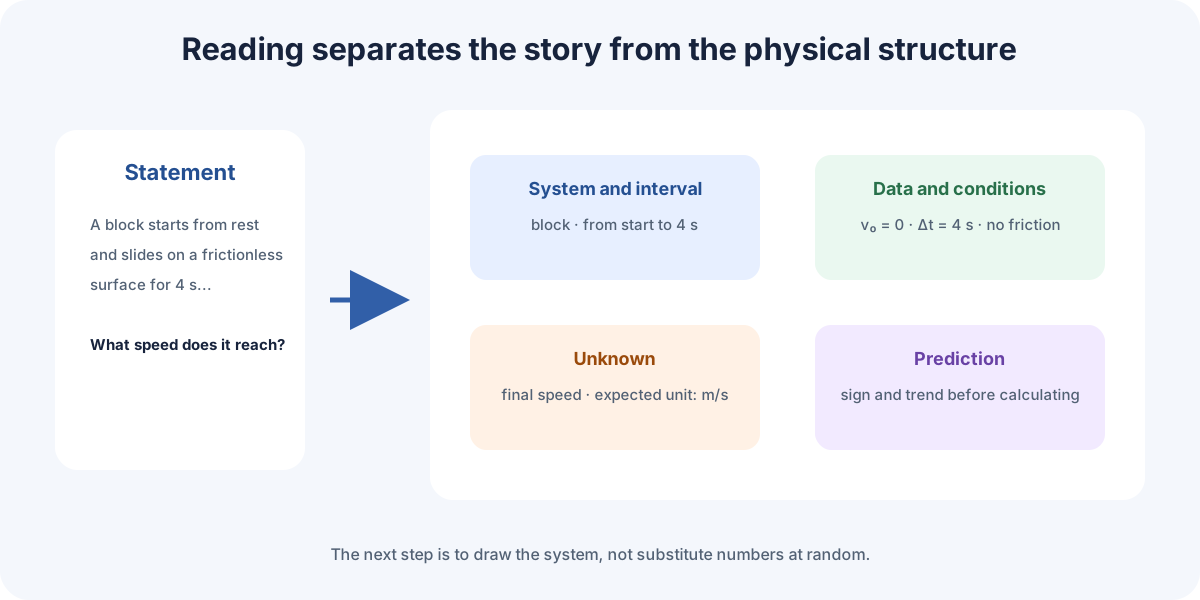
After reading, you should be able to write, without calculating:
- one sentence identifying the system and interval being studied;
- a list of data with symbols, values, and units;
- the stated conditions and approximations;
- the unknown and its expected unit;
- a qualitative description of what should happen.
What not to do yet
Do not substitute numbers, choose an equation because its letters happen to match, or ignore phrases such as "from rest" or "frictionless". Build the meaning first; the diagram and equations come later.
If you cannot explain the problem without equations, you have not finished reading it.
Read the statement in layers
A single reading often mixes narrative, data, and question. Use three brief passes.
First pass: situation
Read without highlighting. Identify the phenomenon, objects, and time sequence. Summarize the problem in one everyday sentence.
Second pass: structure
Mark different functions separately:
- system and surroundings;
- numerical data with units;
- conditions such as rest, equilibrium, isolation, or no friction;
- final question and the place or instant it refers to.
Third pass: coherence
Check whether every datum has meaning, whether an implicit relation is missing, and whether the question contains several tasks. Put events in chronological order when the text does not.
Do not highlight everything: if every word looks important, the essential decisions disappear.
Classify data and unknowns
Organize the information before deciding which equation to use.
| Class | Example | Record it as |
|---|---|---|
| Numerical datum | "travels 20 m" | |
| Condition | "starts from rest" | |
| Model property | "frictionless" | in the model |
| Relation | "constant velocity" | over that interval |
| Unknown | "how long does it take?" | find , unit: s |
Available does not mean necessary
Some statements include contextual or redundant information. Do not remove it immediately: record it and decide its usefulness after choosing the model. A datum absent from the final equation may justify an approximation or check the result.
For several stages, use subscripts or a table: initial, transition, and final. Avoid using the same symbol for values belonging to different instants.
Translate words into physical relations
Translation is not mechanically replacing words with symbols. Each phrase must be interpreted within a particular interval and system.
| Phrase | Usual translation | Caution |
|---|---|---|
| Starts from rest | zero initial velocity | Final velocity need not be zero. |
| Comes to rest | zero velocity at that instant | Acceleration may remain non-zero. |
| Constant velocity | zero acceleration | Only over the stated interval. |
| Equilibrium | zero net force and torque | Decide whether translational, rotational, or both. |
| Falls freely | stated gravitational model acts | Check whether air is neglected. |
| Smooth surface | negligible friction | The normal force remains. |
| Isolated system | negligible external exchange | Identify which quantity is conserved. |
Words such as "maximum", "just before", "relative to", or "uniformly" change the mathematical question. Circle them and write which quantity, instant, or reference they modify.
Detect implicit information
Implicit information comes from definitions, geometry, continuity, initial conditions, or the stated model. It does not mean inventing data.
Questions that reveal it
- Is there a spatial reference or positive direction to choose?
- Do two objects share position, velocity, or time at an event?
- Does an ideal string impose the same length or related accelerations?
- Does a surface constrain motion to a direction?
- Is the final state of one stage the initial state of the next?
- Does a word activate a definition, such as equilibrium or periodicity?
Distinguish inference from assumption
An inference follows from the text or a definition. An assumption simplifies the problem and must be declared. If you need to assume something undetermined by the statement—such as neglecting air—record it and later check whether it fits the level and context.
When two reasonable interpretations produce different models, do not hide the ambiguity: state both or request clarification.
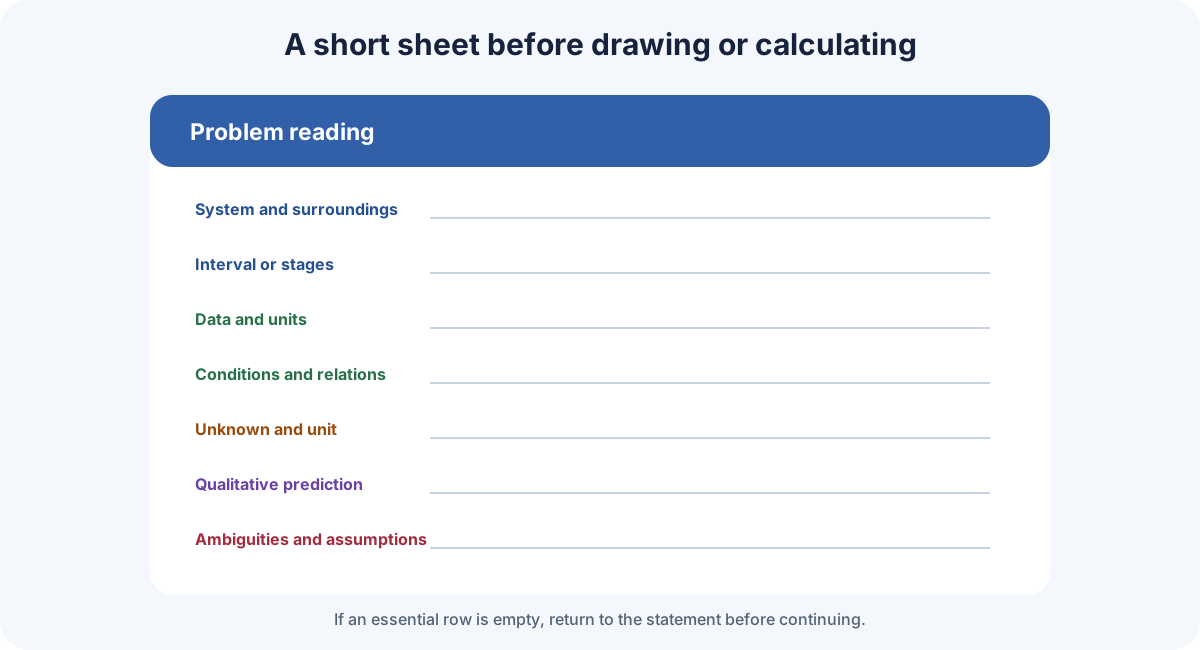
Pre-solution reading sheet
Use this template after the three readings:
| Field | Your note |
|---|---|
| System and surroundings | … |
| Interval or stages | … |
| Required axes and reference | … |
| Data with units | … |
| Explicit conditions | … |
| Implicit relations | … |
| Unknown and expected unit | … |
| Qualitative prediction | … |
| Ambiguities or pending assumptions | … |
Criterion to continue
Move to "Sketch and diagram" when you can explain who interacts with whom, what changes, over which interval, and which quantity you seek. If a datum has no unit, a reference is undefined, or the question is ambiguous, resolve it before drawing or calculating.
The sheet need not be long. Its purpose is to prevent an unchecked decision from becoming hidden among calculations.