Sketch and diagram
A guide to turning the problem reading into a useful sketch, references, and interactions.
Draw to decide
A good sketch is not meant to illustrate the statement; it should make the relations needed for the solution visible.
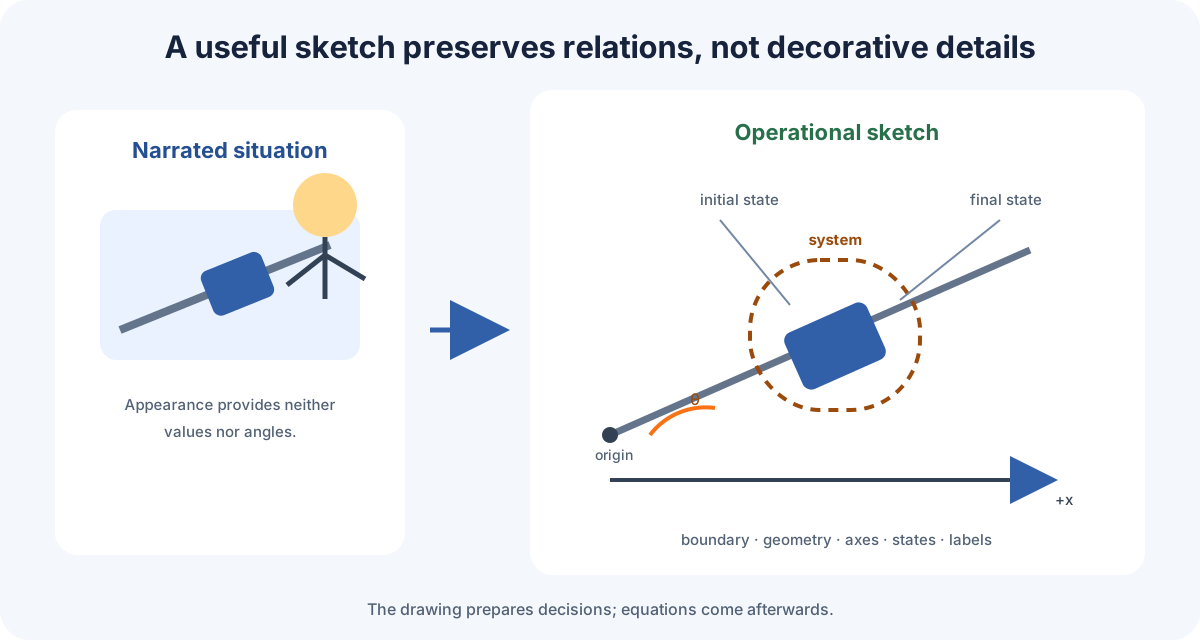
It should help answer:
- which objects belong to the system and which to the surroundings;
- which positions, distances, angles, or instants matter;
- what interacts with what;
- which directions and signs you will use;
- which state is initial, intermediate, or final;
- which quantity is required.
A drawing need not be realistic
Scale, perspective, and shape may be simplified if physical relations are preserved. A clear arrow, boundary, and two labels are often more useful than a detailed illustration.
Do not introduce information absent from the statement: if a slope looks like in your sketch, that does not make it its actual angle.
Choose the system and its boundary
The system is the object or collection to which you will apply a law. Enclose it in a conceptual boundary and place the surroundings outside.
Why it changes the solution
The same situation allows different systems. In a collision, you may study one body, both bodies, or the bodies together with Earth. Each choice changes which interactions are internal or external and which conservation laws are useful.
Questions for choosing it
- Which object's or system's quantity is requested?
- What must I include to apply the law with fewer unknowns?
- What crosses the boundary: force, energy, mass, charge, or momentum?
- Does the system change between stages?
If you use several systems, name them and draw a separate boundary for each analysis. Do not silently change systems between equations.
Geometry, axes, and references
A signed value only has meaning relative to a declared reference.
In the sketch
- draw axes and mark their positive directions;
- place the origin when it affects positions or potentials;
- label angles relative to the correct axis or surface;
- distinguish distance traveled from displacement;
- mark initial and final states with subscripts;
- use construction lines for components, heights, or radii.
Choose useful axes
Axes need not be horizontal and vertical. On an incline, one axis parallel and one perpendicular to the surface are often convenient. In circular motion, radial and tangential directions may simplify equations.
A useful orientation reduces components; it does not change the physics. A negative result says that the actual quantity points opposite to the chosen positive axis, not necessarily that the method is wrong.
Interactions and free-body diagrams
The sketch shows the complete situation. The FBD isolates one system and represents the external forces acting on it.
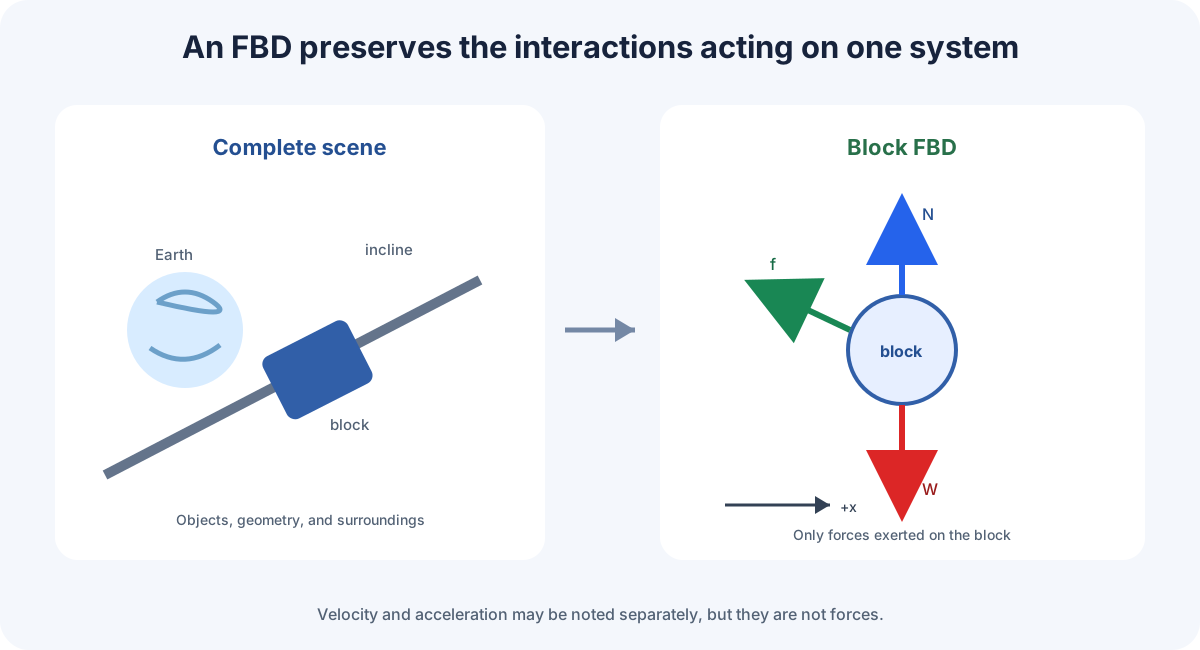
Build an FBD
- Choose and isolate one system.
- Review every interaction with the surroundings.
- Draw one force per interaction, acting on the system.
- Label agent, type, and direction: weight, normal, tension, friction, or another force.
- Add axes and resolve vectors only when useful.
Do not include
- forces exerted by the system on other objects;
- velocity or acceleration drawn as though they were forces;
- the "net force" in addition to all its components, except as a separate construction;
- action-reaction pairs on the same FBD: they act on different bodies.
Arrow lengths may remain qualitative until magnitudes are known. Do not assume equilibrium by drawing them equal.
Choose the right representation
Not every problem needs the same drawing. Use the representation that makes the decisive relation visible.
| You need to understand | Useful representation |
|---|---|
| Objects, path, and positions | Spatial sketch or sequence of states |
| Forces on a system | FBD |
| Rays, angles, or optical geometry | Ray diagram |
| Circuit and connections | Circuit diagram |
| States and energy transfers | Energy diagram |
| Evolution or relation between variables | Coord graph |
| A multi-stage process | Timeline or state diagram |
You may need two complementary representations. For example, a sketch places a block on an incline and a separate FBD shows its forces. Do not mix every layer if the result becomes unreadable.
Coord, SVG, and FBD views available in some leaves may serve as visual references, but your sketch must match the data and conditions of your particular problem.
Check before setting up equations
A sketch is ready when it lets you construct relations without repeatedly returning to the text.
Checklist
- The system and its boundary are identified.
- Objects and states have distinct names.
- Data and unknowns use consistent symbols.
- Axes, origin, and positive direction are declared.
- Angles, distances, and geometric constraints use the correct references.
- Every relevant interaction appears once.
- No values have been invented from the drawing's appearance.
- Different stages are separated and connected.
Explanation test
Cover the statement and narrate the problem using only the sketch. Then compare: add any missing essential condition and remove decoration that plays no role.
When you can point to the drawing and state which principle applies to which system, continue to "Set-up and equations".