Dimensional analysis
A guide to checking homogeneity, inferring dependencies, and detecting impossible equations.
Dimensions and units
A dimension describes the physical nature of a quantity; a unit states how it is measured within a particular system.
| Quantity | Dimension | Possible SI unit |
|---|---|---|
| Length | meter, | |
| Mass | kilogram, | |
| Time | second, | |
| Velocity | ||
| Force | newton, | |
| Energy | joule, |
A length retains dimension whether expressed in meters or kilometers. Changing units alters the numerical value but not the dimension.
Dimensionless quantities
A ratio of quantities with equal dimensions may be dimensionless: strain, refractive index, or an angle in radians. "Dimensionless" does not mean meaningless, nor does it mean that scale and convention are irrelevant.
Dimensional homogeneity
Every term being added or subtracted must have the same dimension, and both sides of a physical equation must be dimensionally equivalent.
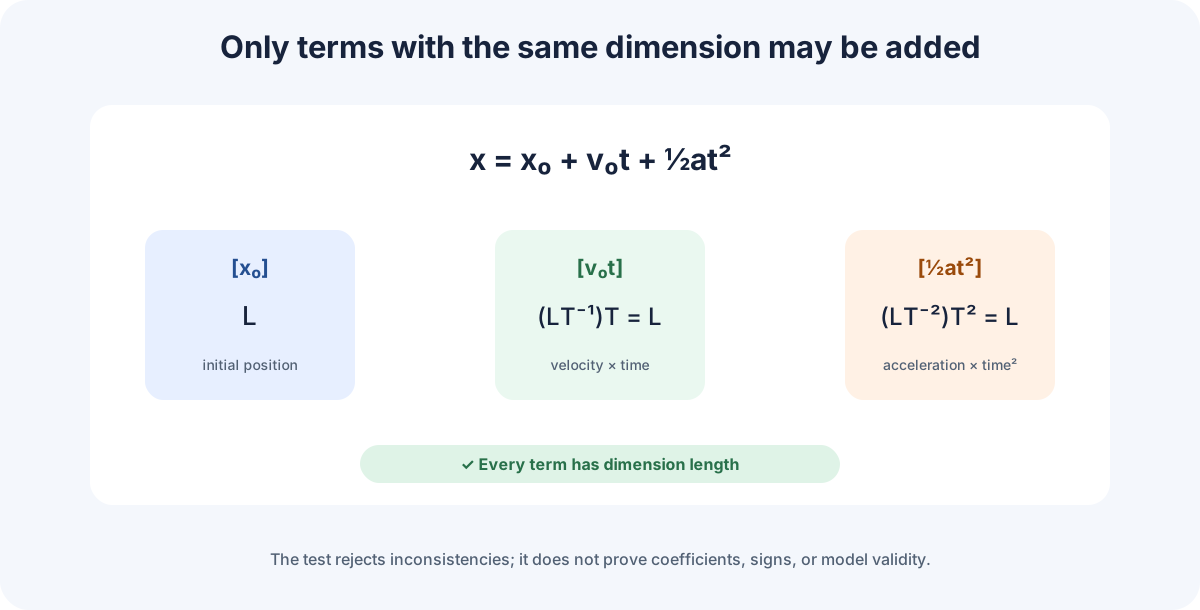
For
[
]
every term represents a length:
[
]
The factor is dimensionless and does not affect the test.
Mathematical functions
The argument of an exponential, logarithm, or trigonometric function must be dimensionless. Expressions such as are valid because has no dimension; is complete only if already denotes a dimensionless variable.
Checking method
- Replace every quantity by its fundamental dimensions.
- Apply powers to the complete dimension: .
- Add exponents when multiplying and subtract them when dividing.
- Simplify every term separately.
- Compare added terms and both sides.
Short example
Check :
[ [mv^2]=M(LT^{-1})^2=ML^2T^{-2}=[E]. ]
The expression passes the dimensional test. This does not yet prove the factor is , that the correct velocity was used, or that the model applies.
With compound units
You may also reduce units: . Do not mix abstract dimensions and numerical conversion factors in the same line.
Infer the form of a relation
If you know the relevant variables but not the exact equation, dimensions can constrain its form.
Suppose a pendulum period depends on length and gravity :
[
]
Comparing dimensions:
[ T=L^a(LT^{-2})^b=L^{a+b}T^{-2b}, ]
gives and , hence
[
]
What remains undetermined
Dimensional analysis does not recover the dimensionless factor , nor does it reveal other relevant dimensionless variables by itself. The result describes a compatible family, not necessarily the complete law.
The technique can also build dimensionless groups and compare systems at different scales, provided the relevant variable set was chosen correctly.
Errors it can detect
Dimensional analysis quickly identifies:
- sums of incompatible quantities;
- forgotten powers or powers applied to only part of a unit;
- missing factors of time, length, or mass;
- confusion between related quantities, such as energy and power;
- dimensional arguments inside logarithms or exponentials;
- results reported in a unit belonging to another quantity.
Locate the first failure
Do not check only the final expression. Review every derivation line and find the first one where the expected dimension changes. That line contains the error or an unstated definition.
What it suggests but cannot decide
If a dimension is missing, a frequency, velocity divided by length, or another time scale may have been omitted. The test guides the search, but the physical model determines the correct factor.
Limitations of dimensional analysis
Passing the test is necessary but not sufficient. Two incorrect expressions may have the same dimensions.
Dimensional analysis cannot determine by itself:
- dimensionless numerical constants such as , , or ;
- signs, directions, or vector character;
- sums between terms of equal dimension;
- arbitrary functions of dimensionless variables;
- initial conditions, boundary conditions, or validity domain;
- whether the relevant variables were chosen correctly.
For example, and are dimensionally compatible, but only the model and its derivation fix the coefficient.
Combine this test with order of magnitude, limiting cases, physical meaning, and assumption review. A strong check uses independent evidence.