Order of magnitude
A guide to estimating scales, comparing powers of ten, and detecting implausible results.
What an order of magnitude is
Order of magnitude places a quantity on an approximate power-of-ten scale. It distinguishes millimeters, meters, and kilometers before decimals are discussed.
In scientific notation,
[
]
The power identifies the decimal scale. Under the nearest-power convention, the order becomes when . For routine checking, the important points are to state the convention and detect large discrepancies.
Order is not precision
Saying a length is of order does not claim it equals exactly . It summarizes scale and tolerates moderate factors, not differences of thousands or millions.
Estimate before calculating
An independent estimate prevents blind acceptance of calculator output.
- Round each datum to an easy value: , .
- Separate coefficients and powers of ten.
- Operate mentally on the powers.
- Retain only the scale and, when useful, an approximate bound.
- Predict unit, sign, and trend as well.
Example
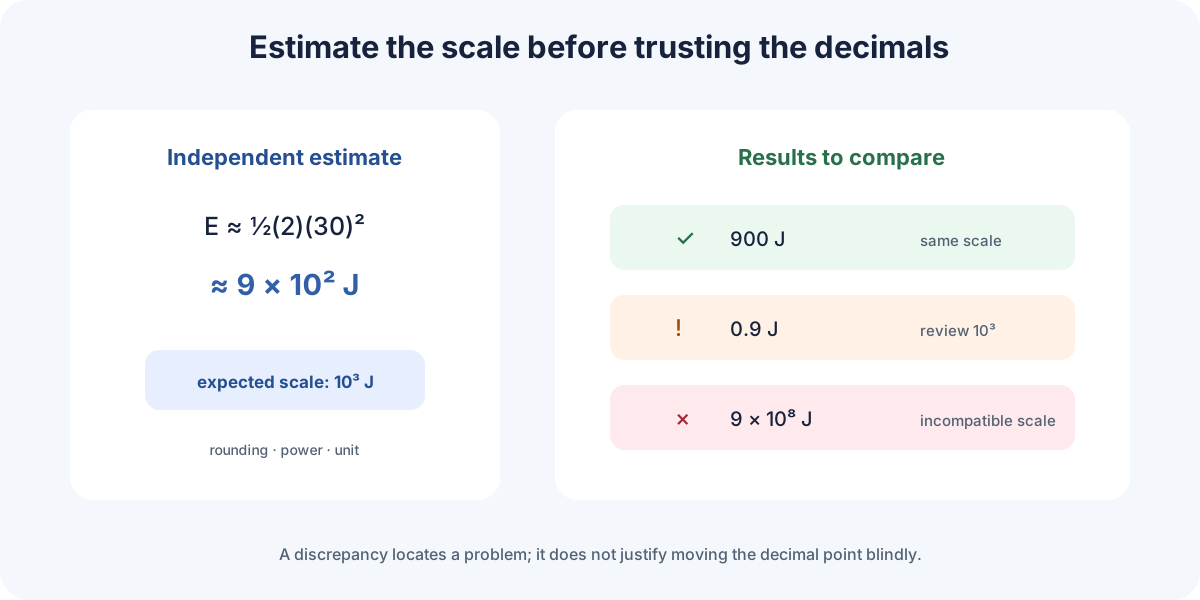
For , with and :
[
]
A result of is compatible; or demands a review of units, exponents, or input.
The estimate should follow a sufficiently independent route so that it does not repeat the same algebraic mistake.
Powers of ten and prefixes
Prefix errors frequently cause discrepancies of several orders of magnitude.
| Prefix | Symbol | Factor |
|---|---|---|
| giga | G | |
| mega | M | |
| kilo | k | |
| centi | c | |
| milli | m | |
| micro | ||
| nano | n |
Powers on units
The factor is raised as well:
[
]
Do not substitute 3 km as 3 when the remaining data use SI. First write .
Case and symbols matter: M and m denote very different prefixes, and a unit symbol may match a variable symbol without sharing its meaning.
Bounds and reference values
An estimate improves when it does not depend on remembering an exact value.
Build bounds
If every factor is positive and and , you can bound products without solving exactly. Choose consistent extremes and take care with division, negative powers, and non-monotonic functions.
Useful references
Compare the result with:
- human scales: height, stride, mass, or reaction time;
- Earth scales: , radius, or day length;
- values within the problem: initial energy, available distance, or total time;
- physical limits: light speed, probabilities from 0 to 1, or efficiencies no greater than 100%.
Do not use a remembered reference as high-precision data. Its role is to detect large incompatibilities.
Compare estimate and result
Write both in scientific notation and mentally calculate the discrepancy factor.
| Comparison | Initial reading |
|---|---|
| Same order and nearby factor | Plausible result; continue checking. |
| Moderate difference | Review rounding, approximation, and coefficients. |
| Difference of , , etc. | Suspect prefixes or conversions. |
| Approximately doubled exponent | Review squares, roots, and parentheses. |
| Result outside a physical bound | Model, data, or calculation are incompatible. |
Diagnose; do not correct blindly
Do not move the decimal point merely to obtain the expected scale. Return to the first line where the wrong power appears: converted data, symbolic equation, substitution, or calculator input.
If estimate and calculation differ, either may be wrong. Review the chosen reference and the assumptions used in the estimate as well.
Limitations of the check
A reasonable order does not prove that the result is correct. Many different values share the same scale.
This test may not detect:
- moderate numerical factors;
- wrong signs or directions;
- an auxiliary quantity mistaken for the requested one;
- incorrect models producing a similar scale;
- cancellations between large terms;
- behavior near singularities or thresholds.
The estimate may also fail if you round quantities that nearly cancel or if a function is highly sensitive to one parameter.
Combine order of magnitude with dimensions, limiting cases, sign, conservation, and model domain. Agreement in scale is favorable evidence, not certification.