Signs and directions
A guide to defining references, interpreting components, and avoiding sign and direction errors.
A sign belongs to a convention
A positive or negative sign has no complete physical meaning until the reference is declared. “To the right,” “downward,” or “into the system” may all be chosen as positive provided the convention remains consistent.
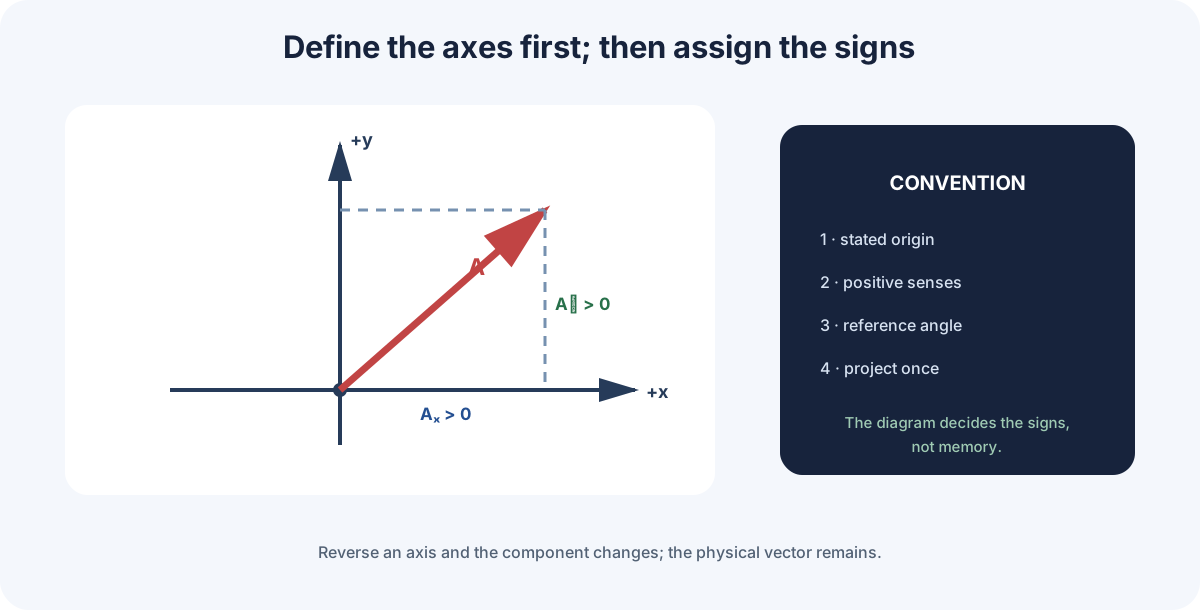
Separate three ideas
- Physical direction: the line or axis along which a quantity acts.
- Physical sense: one of the two possible orientations along that direction.
- Algebraic sign: the code indicating the sense relative to the chosen axis.
The sign does not change the phenomenon. Reversing an axis transforms components and equations, but a consistent observable prediction must describe the same reality.
Before writing equations
State the system, origin, axes, and positive senses on the diagram. If an external convention applies—current, flow, potential difference, or work—record it too. This decision makes every later sign checkable.
Axes, origin, and positive sense
Choose the reference to simplify the problem, not out of habit.
Useful choices
- On an inclined plane, axes parallel and perpendicular to the surface reduce components.
- In vertical motion, choosing up or down as positive is valid; signs change, not the physics.
- In circular motion, radial and tangential directions are often more informative than (x) and (y).
- In rotation, state the axis and positive angular sense using a consistent rule.
The origin determines positions but does not alter displacements between two points. A different initial time changes a function's expression, not the same physical event.
Do not switch halfway through
If you must redefine an axis, begin a new line, state the transformation, and convert every component. Changing only the inconvenient sign mixes two reference systems.
You may use different axes for several bodies, but label each set and relate shared constraints correctly.
Vectors, magnitudes, and components
A vector is not wholly “positive” or “negative.” Its components may have signs relative to each axis.
For a vector with magnitude and angle , the expressions
[
]
are correct only when the angle is measured from the stated axis and in the stated sense. The quadrant determines the signs.
Do not duplicate the sign
If a force points left and its calculated component is already negative, do not add another minus sign merely because it points “the other way.” Choose either to:
- use the positive magnitude and assign the sign during projection; or
- enter an algebraic component that already includes its sign.
Do not mix both strategies in the same term.
Magnitude versus component
The magnitude is nonnegative. A component, change, work, or flow may be negative. Check which quantity the problem asks for before removing a sign with an absolute value.
Interpret a negative result
A negative result does not automatically mean the calculation is wrong. First translate the sign through the chosen convention.
| Quantity | Possible reading of a negative value |
|---|---|
| Position | It lies on the negative side of the origin. |
| Displacement | The net change points against the positive axis. |
| Velocity | Motion is in the axis's negative sense. |
| Acceleration | It points in the negative sense; this does not always mean slowing down. |
| Work or power | Transfer opposes the defined energetic sense. |
| Change | The final value is smaller than the initial value. |
| Calculated time | The event lies before the time origin, or the root does not belong to the requested interval. |
Acceleration and slowing down
An object slows down when velocity and acceleration have opposite signs and speeds up when they share a sign. The acceleration sign alone does not determine whether it is slowing.
Roots and solutions
An equation may produce several algebraic solutions. Reject one only when it conflicts with the domain, initial conditions, or question—not merely because it is negative.
Frequent mistakes and how to spot them
| Mistake | Symptom | Correction |
|---|---|---|
| Axis not stated | Signs change between lines. | Draw and label the positive sense. |
| Signing both magnitude and projection | A force ends up pointing the opposite way. | Use one sign strategy only. |
| Treating negative as “slowing” | Acceleration is interpreted incorrectly. | Compare the signs of (v) and (a). |
| Always using | Inconsistency when downward is positive. | is a magnitude; its component depends on the axis. |
| Swapping sine and cosine | Components conflict with the diagram. | Identify the side parallel to the angle's reference axis. |
| Applying absolute value at the end | Direction information is hidden. | Interpret the sign before deciding. |
| Confusing action and reaction | Opposite forces are canceled on one body. | State which body each force acts on. |
| Mixing clockwise and counterclockwise | Torques and angles become inconsistent. | State the axis and angular sense once. |
If an equation works only after manually “fixing” a sign, return to the diagram and projections. The error usually appears before the final result.
A safe method for working with signs
Use this sequence before and during every problem:
- Isolate the system: decide which body or region you are analyzing.
- Draw the situation: separate geometry from forces or velocities if needed.
- Define references: origin, axes, positive senses, and angles.
- Represent vectors physically: do not force algebraic signs yet.
- Project once: assign the sign relative to each axis.
- Write scalar equations: keep the convention through to the end.
- Interpret the result: translate the sign into a direction, sense, or transfer.
- Check: reconstruct the vector or mentally reverse the axis; the physical prediction must remain unchanged.
Closing sentence
Do not stop at “.” Write: “With right defined as positive, the object moves at to the left.”
In a Phyxio plot or simulation, first check which axis and reference it uses. In Experiment mode, vary the conditions and observe when a component crosses zero; do not confuse that sign change with a discontinuity in the motion.