Units and conversions
A guide to harmonising units, converting safely, and detecting incorrect scale factors.
Quantity, unit, and numerical value
A measurement combines a physical quantity, a number, and a unit:
[ Q={Q}[Q]. ]
In , the quantity is length, is the numerical value, and is the chosen unit.
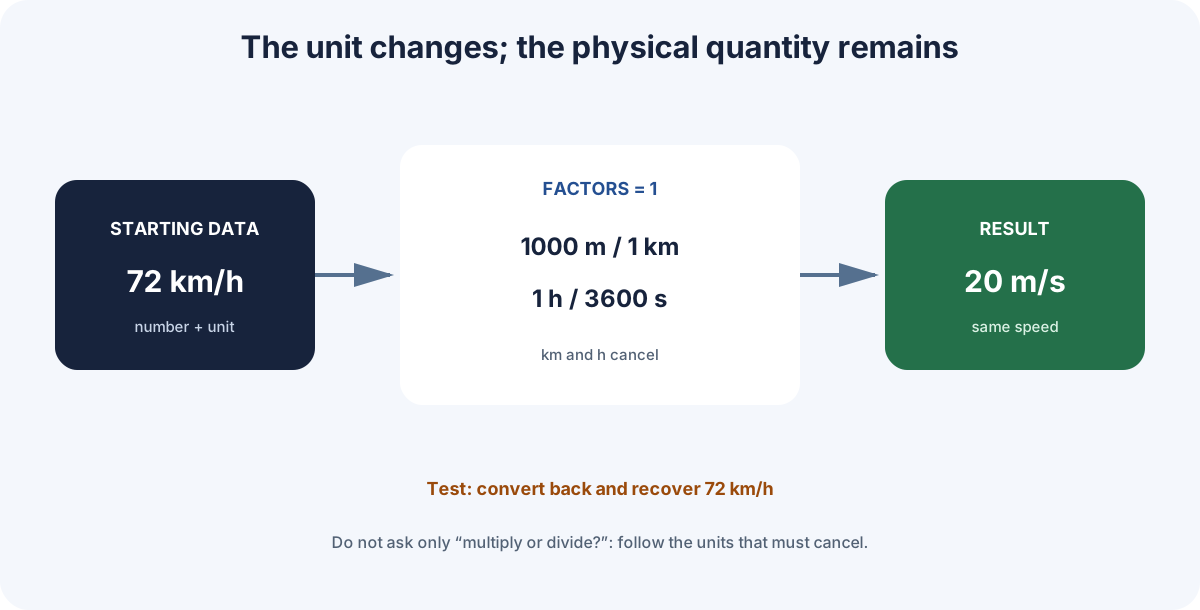
Changing the unit changes the number but not the physical quantity:
[
]
Dimension is not unit
Dimension describes the physical type—length (L), time (T), mass (M)—whereas a unit sets a specific scale. Meter and kilometer have dimension (L), while joule and newton are not interchangeable even though both are derived units.
Always keep number and unit together. Unitless input is valid only when it is genuinely dimensionless or when the context explicitly states the convention being used.
Harmonize before calculating
Formulas do not always require SI, but they do require a compatible set of units. Mixing kilometers with seconds and an acceleration in introduces hidden factors.
Preliminary inventory
- Write every datum with symbol, value, and unit.
- Identify the expected unit of the result.
- Choose a coherent system, normally SI.
- Convert the inputs before substitution.
- Keep units throughout the operation.
Example: to use with and :
[
]
When not to convert
If every quantity forms a coherent system and the final unit is clear, conversion to SI may be unnecessary. In a ratio of two lengths, for example, equal units cancel. State the decision so it can be checked.
Do not convert only the final unit after mixing incompatible scales inside the calculation.
Convert using unit factors
A conversion factor is a fraction equal to one. Orient it so that the starting unit cancels:
[
]
Units behave algebraically: and cancel, leaving .
Traceable chain
For several conversions, keep every factor in one chain. This reveals:
- which equality was used;
- whether each factor is oriented correctly;
- which units cancel;
- which unit must remain.
If a unit does not cancel, the factor is inverted or a step is missing. This check is safer than remembering whether to “multiply or divide.”
Conversions with an offset, such as some temperature scales, are not simple multiplicative factors: use the complete relation and do not cancel symbols as though they were ratios.
Prefixes, powers, and compound units
A prefix multiplies the unit by a power of ten. Uppercase and lowercase matter: , whereas .
| Prefix | Symbol | Factor |
|---|---|---|
| giga | G | |
| mega | M | |
| kilo | k | |
| centi | c | |
| milli | m | |
| micro | ||
| nano | n |
Raise the whole unit
The exponent applies to both the factor and the unit:
[
]
[
]
This mistake explains frequent discrepancies of , , or .
Compound units
Treat numerator and denominator separately. For density, pressure, or acceleration, first write the unit as a product of powers. Remember that dividing by a converted unit also inverts its factor.
Radians are dimensionless in SI but retain angular information. Do not confuse degrees with radians when using trigonometric functions or calculators.
Frequent mistakes and their signals
| Mistake | Typical signal | Corrective action |
|---|---|---|
| Substituting unitless data | The formula cannot be audited. | Keep units until simplification. |
| Mixing scales | Result shifted by , , … | Harmonize before calculating. |
| Inverting a factor | The starting unit does not cancel. | Orient the fraction by cancellation. |
| Ignoring squares or cubes | Error of , , … | Raise number and unit together. |
| Confusing mass and weight | and are mixed. | Identify the quantity first. |
| Confusing energy and power | and are mixed. | Check whether a time interval is involved. |
| Confusing angular frequency | and are mixed. | Check the factor. |
| Using degrees in radian mode | Trigonometric result is inconsistent. | Check the calculator mode. |
| Converting temperatures as ratios | Incorrect offset. | Apply the complete affine equation. |
If the result differs from an estimate by a clean power of ten, check prefixes, exponents, and scientific notation first. If it differs by , , , or , look for a specific conceptual conversion.
Method and final check
Safe sequence
- Identify the requested quantity and target unit.
- Inventory all input values and units.
- Choose a coherent system.
- Convert with written factors, not mentally when several steps are involved.
- Substitute values and units into the formula.
- Cancel and simplify units before accepting the number.
- Check dimension, order of magnitude, and reverse conversion.
- Report the result with a justified unit and precision.
Three quick tests
- Cancellation: did the expected starting units disappear?
- Scale sense: when changing to a smaller unit, did the numerical value increase?
- Round trip: does conversion back to the original unit recover the input?
Phyxio's Converter lets you select categories and source and target units. Use it to verify a manual conversion or solve an everyday chain, but confirm that you chose the same quantity and read the displayed factor. The tool cannot correct a wrongly chosen physical category.
Save recurring conversions and their base equality in your notes; avoid memorizing disconnected rules such as “multiply by one thousand” without knowing the starting and target units.