How to learn from errors
A guide to turning mistakes into specific actions for correction, practice, and follow-up.
Error as evidence
An error signals a difference between your model of the task and what the problem requires. It becomes learning only when that difference produces a checkable action.
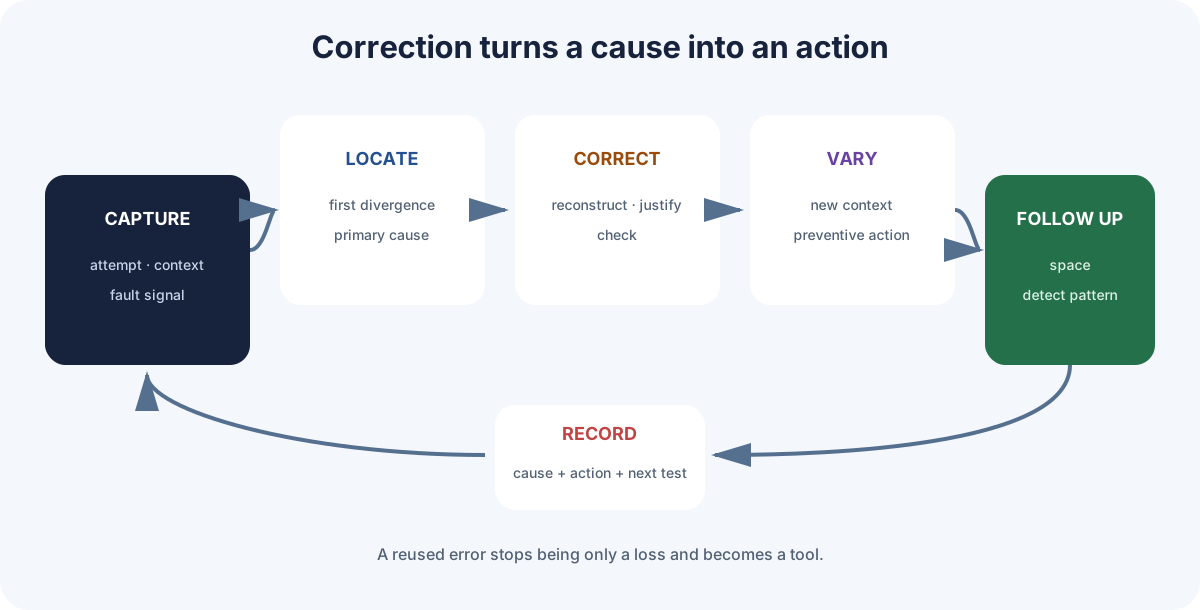
Separate outcome and cause
“I got it wrong” describes the outcome, not the cause. The same incorrect value may begin with:
- interpreting a different quantity;
- choosing an unsuitable model;
- forgetting a condition;
- converting a unit incorrectly;
- losing a sign or parenthesis;
- typing a different expression;
- rounding too early;
- communicating incompletely.
Avoid personal labels
Replace “I am bad at dynamics” with a local description: “when I choose global axes on inclined planes, I duplicate the sign of one component.” The second statement supports a corrective action.
Correct answers may also be fragile
A correct result obtained by chance, compensating errors, or an unexplained rule deserves review. Ask whether you could justify the step and repeat it when the data change.
Do not try to eliminate every error. Aim for mistakes to appear during practice, become visible, and never return without leaving information.
Capture the attempt before correcting
If you immediately erase the solution, you lose the trail that allows the fault to be located.
Preserve four layers
- Statement and question: which information you received and what was asked.
- Formulation: system, drawing, model, assumptions, and equations.
- Execution: rearrangement, substitution, units, and calculator input.
- Conclusion: result, interpretation, and checks.
Mark where you first noticed that something did not fit, but do not assume that point is the original cause.
Add context
Record whether you worked under a time limit, which aids you used, which part caused doubt, what you expected, where the correction comes from, and whether the error appeared before.
A screenshot preserves an output but not always the intention. Add one sentence explaining what you were trying to do.
Before viewing the solution
Predict the cause and try an independent check: dimensions, estimate, limiting case, inverse substitution, or drawing. Then consult the correction.
Do not overwrite the original attempt. Place the correction beside it so that the first divergence remains visible.
Classify and locate the first divergence
The category guides where to look; the first divergence identifies what to correct.
| Category | Diagnostic question |
|---|---|
| Reading | Did I answer the requested quantity, object, and state? |
| Representation | Does the drawing, axis, or plot match the system? |
| Concept | Did I understand the principle and quantities? |
| Model | Are the assumptions and domain appropriate? |
| Strategy | Did I choose a relation connecting data and unknown? |
| Algebra and calculation | Does the transformation preserve equivalence and restrictions? |
| Units and data | Did I convert, copy, and substitute correctly? |
| Checking | Did I ignore a signal that would have revealed the fault? |
| Communication | Did I show steps, unit, sign, and conclusion? |
| Management | Did time, order, or use of aids harm execution? |
Comparison technique
Compare the attempt and solution from top to bottom. Stop at the first line where a definition, condition, equation, or transformation differs. Later differences may be consequences.
Find the cause, not only the location. Ask “which decision would have prevented this fault?” and correct first the cause that would have changed the whole route.
Correct and reconstruct
Copying the correct solution removes the symptom but does not guarantee that you can produce it later.
Correction in four steps
- Explain the cause: one specific, checkable sentence.
- Repair the section: redo from the first divergence.
- Justify the new decision: principle, rule, or evidence.
- Check: use a route different from the correction received.
Then close the solution and reconstruct the complete problem or its essential step.
Design a preventive action
Connect cause and action:
- unstated axis → draw and label before projecting;
- mixed unit → inventory and conversion beforehand;
- wrong model → write assumptions and domain;
- lost parenthesis → retain the symbolic expression and reread input;
- formula chosen by resemblance → name the principle first;
- uninterpreted result → close with meaning and conditions.
The action must be observable in the next attempt. “Be more careful” does not state what you will do.
Practise a variation
Change one datum, orientation, requested variable, or condition. If you can only repeat the identical example, you may remember the correction without having generalized the decision.
Leave an interval and retrieve again. Immediate correction demonstrates momentary understanding; later retrieval shows whether it remains available.
Keep a useful log in Phyxio
An error log should not become an archive of complete solutions. Retain the information required to recognize and prevent the pattern.
Minimum record
- context: leaf, problem, or situation;
- signal: how you discovered the fault;
- first divergence: exact step;
- cause: brief explanation;
- correction: correct decision or principle;
- preventive action: what you will do next time;
- variation: task used to check it;
- follow-up: when you will return.
Personal room
Save the record or note beside the related node or leaf. Use searchable titles, for example:
- “Inclined plane · duplicated sign”;
- “Waves · confuse frequency and angular frequency”;
- “Laboratory · uncertainty rounded too early.”
Group by pattern when several topics share the same cause. Do not save sensitive data or assessed material whose storage or distribution is not permitted.
Links within Phyxio
Connect the record with:
- the conceptual leaf that corrects the idea;
- “Common Errors” for prevention;
- “Checking Results” for the diagnostic signal;
- a calculator, plot, or simulation when useful for comparison;
- the study plan and review date.
Archive or summarize entries that are already consolidated. The log should show current priorities rather than grow without limit.
Close the error cycle
An error is not closed when you read the correction, but when you can prevent or detect it in a new context.
Closure criteria
- you can explain the cause without looking;
- you redo the correct step and justify it;
- you solve a variation;
- you recognize the warning signal;
- you apply the preventive action;
- you retrieve the decision after an interval.
You do not need to avoid the mistake forever. If it reappears, it should be detected earlier and provide additional information.
If the error repeats
Review whether:
- the recorded cause was only a symptom;
- a prerequisite is missing;
- the preventive action is too vague;
- you practiced only identical examples;
- the interval was excessive;
- time pressure changes your procedure;
- you need another representation or support.
Use Phyxio AI
You can ask Phyxio AI—the mascot Phyxi—to compare the attempt and correction, suggest alternative causes, or generate a variation. Include the statement, your formulation, the divergence point, and the preventive action. Do not accept its diagnosis without checking it against the leaf and reconstructing the solution yourself.
Turn patterns into improvements
Review the log periodically and count patterns rather than only entries. If many losses come from units, signs, or reading, add a fixed check to every solution.
The final goal is not to collect corrected errors, but to turn repeated patterns into more reliable working habits.