Exam preparation
A guide to preparing for, taking, and reviewing physics exams with a realistic strategy.
Know the exam
Good preparation requires knowing what will be assessed and under which conditions, not trying to master all of physics to the same depth.
Information to gather
- content and prerequisites;
- date, duration, and approximate number of sections;
- question types: conceptual, derivation, problem, plot, or laboratory;
- weight of each block and marking criteria;
- permitted material: calculator, formula sheet, tables, or none;
- expected units, notation, and answer format;
- examples, past papers, or teacher guidance.
Do not infer the format from one old exam alone. Confirm whether the conditions have changed.
Turn the syllabus into a route
Connect each syllabus block with Phyxio nodes and leaves. Identify:
- foundations that unlock several problems;
- frequent procedures;
- connections between topics;
- mistakes that often lose marks;
- checks that help recover marks.
The goal is not to read every available leaf, but to select which content supports each real demand of the exam.
If the criteria are ambiguous, ask for clarification early. An assumption about the exam should not silently become the center of the whole plan.
Prepare in phases
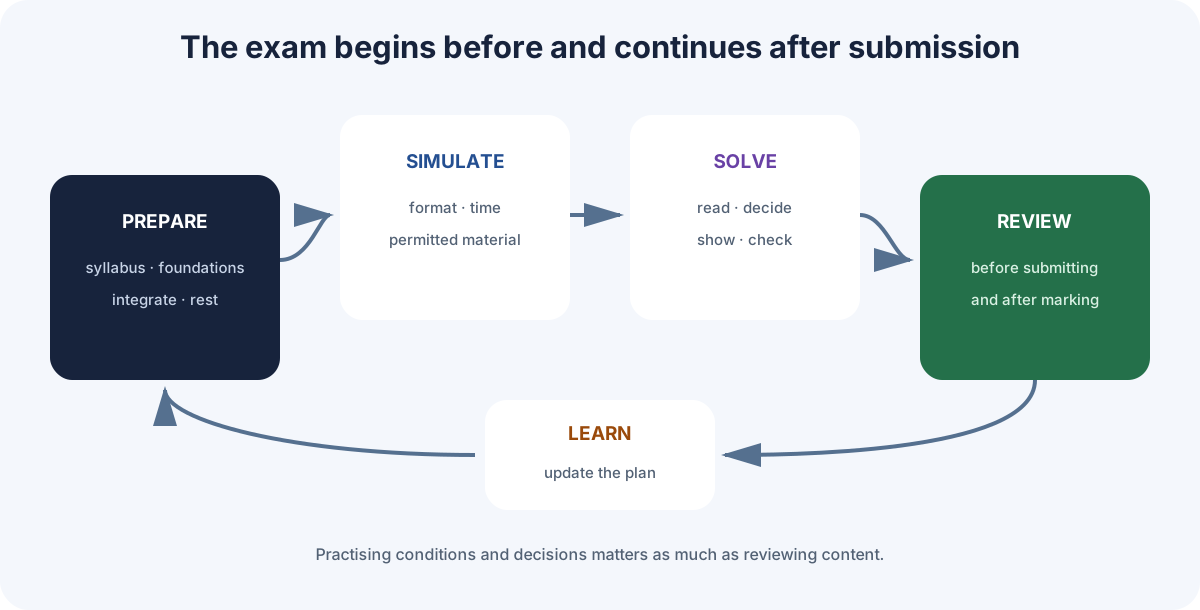
Preparation changes function as the date approaches.
Phase 1 · Build
- understand concepts and models;
- retrieve prerequisites;
- practice procedures separately;
- connect equation, plot, and meaning;
- record errors from the beginning.
Phase 2 · Integrate
- mix topics and question types;
- solve without being told the method;
- explain why a strategy applies;
- combine problems with a final check;
- use moderate time limits.
Phase 3 · Simulate
- practice with a format and duration close to the exam;
- restrict aids to the material actually permitted;
- make decisions about order and time;
- correct afterwards using a consistent criterion.
Phase 4 · Consolidate
- review high-impact errors;
- retrieve formulas with their meaning and domain;
- complete short tasks rather than exhausting sessions;
- prepare materials and logistics;
- protect sleep and rest.
Do not leave all integration until the final days. Do not turn the previous evening into an extreme simulation that adds fatigue and leaves no time for correction.
Distribute these phases within your weekly plan according to the available time, not a rigid universal calendar.
Practise under realistic conditions
A simulation trains decisions under constraints; it is not only a way to obtain a score.
Before
- select a representative set;
- fix the duration and permitted material;
- prepare paper, calculator, and authorized constants;
- define the marking criterion you will use;
- avoid knowing the method for each section in advance.
During
Record discreetly:
- starting time and question changes;
- points where you became stuck;
- decisions made with uncertainty;
- sections left for later;
- checks performed.
Do not consult Phyxio during a simulation if it will not be available in the exam. Its value appears before, during preparation, and afterwards, during correction.
Afterwards
Separate:
- knowledge you could not retrieve;
- incorrect model choice;
- algebra or calculator error;
- misinterpretation;
- insufficient time;
- inadequate presentation.
Redo only after diagnosing. Immediately repeating the same paper from memory can create a false impression of improvement.
Use Phyxio to return to the specific leaf, reconstruct the method, and practice a variation. Later repeat a comparable task, not necessarily the identical one.
Strategy during the exam
Your strategy should help you show what you know clearly and preserve time for checking.
First reading
Read the instructions, page count, marks, and restrictions. Scan the questions and identify:
- exactly what is requested;
- apparent difficulty;
- dependencies between sections;
- shared data or formulas;
- approximate time in proportion to the marks.
Solve one section
- Define the system, references, and unknown.
- Organize data and units.
- Draw when it clarifies geometry or interactions.
- State the principle, model, and assumptions.
- Work symbolically before substituting.
- Keep enough steps for the reasoning to be assessable.
- Report the result with unit, sign, and precision.
- Perform at least one quick check.
Do not write only a number even when it is correct. Visible structure allows credit for the method and makes errors easier to locate.
Question order
You may begin with accessible sections to secure progress, provided you mark clearly what remains. Do not switch so often that you lose context and time.
If an earlier result feeds another section, use a symbolic variable or state that you continue with the value obtained. Do not automatically abandon the whole problem because of one earlier fault.
Manage blocks and time
A block is a signal to change the mental operation, not to repeat the same line indefinitely.
Unblocking protocol
- Rewrite in one sentence what the section asks.
- Draw or list the data, unknown, and conditions.
- Identify the physical principle before a specific formula.
- Look for a simple case, a conservation law, or a known relation.
- Write what you do know symbolically.
- If you do not advance after a reasonable limit, mark it and continue.
Leave space for returning. Note one word about the obstacle: “model,” “rearrangement,” “datum,” or “sign.” You will not need to restart from zero.
Time budget
Allocate time roughly in proportion to the marks and reserve a final portion for review. Check the clock at milestones, not every minute.
Signals to change section:
- you have spent too long without producing an assessable step;
- a secondary operation consumes more time than the main idea;
- you are recalculating the same thing without new evidence;
- accessible questions remain untouched.
Reduce activation
Pause for a few seconds, place your feet on the floor, breathe slowly, and return to one specific action. Do not try to solve both the problem and fear about the result at the same time.
If exam anxiety is intense or persistent, seek support from a teacher, adviser, or professional. A study guide does not replace that help.
Review and learn afterwards
Review before submitting
Prioritise high-impact checks:
- have you answered every section?
- does each answer belong to the requested system and state?
- are units, signs, vectors, or justified figures missing?
- are any inputs unconverted or exponents entered incorrectly?
- does the result pass order-of-magnitude and physical-meaning checks?
- are pages, plots, and sections identified?
Do not completely redo a correct solution merely because time remains. First look for specific signals of error.
After the exam
Before receiving the marking, briefly record:
- where you hesitated;
- which time strategy worked;
- which content you could not retrieve;
- which error you suspect;
- what you would change in preparation.
When feedback arrives, compare perception with evidence. Classify each loss by understanding, choice, execution, checking, time, or communication.
Use Phyxio
Return to the exact node or leaf related to the error. Compare your solution with the content, use tools to verify it, and save an actionable note in your room rather than only the correct answer.
You can ask Phyxio AI—the mascot Phyxi—to critique the structure of your attempt or suggest a variation. Provide the statement, your steps, and the feedback received, then verify its observations.
Post-exam analysis should inform the next study plan. It is not for punishing yourself or indiscriminately repeating the entire syllabus.