Study plan
A guide to turning goals and Phyxio content into a sustainable, adjustable study plan.
Define the starting point
A useful plan begins with your real situation, not with an ideal timetable that cannot be maintained.
Initial inventory
Record:
- the goal and deadline;
- the time genuinely available each week;
- required topics and their importance;
- necessary prior knowledge;
- available materials, problems, and tools;
- personal constraints: classes, work, rest, and other subjects.
Then explore the Phyxio map from the node related to your goal. Observe the node → leaf → tabs hierarchy and identify which content provides foundations, applications, or support.
State of each item
Classify each leaf as:
- new: you cannot yet explain it;
- in progress: you recognize the ideas but still need support;
- functional: you solve ordinary cases and justify the method;
- to review: you previously knew it but need retrieval.
This classification guides time; it is not an in-guide self-assessment or a permanent label. If you do not know where to begin, choose the closest prerequisite you cannot yet use confidently.
Turn aims into usable goals
“Study mechanics” is too broad an intention. An operational goal states content, action, conditions, and evidence.
By the end of [period], I will be able to [observable action] with [content], using [conditions or tools], and I will retain [result or explanation] as evidence.
Example: “By the end of the week, I will be able to formulate free-body diagrams on inclined planes and explain the sign of every component without consulting the solution.”
Prioritise
Order each goal using four questions:
- Is it a prerequisite for other topics?
- Does it appear frequently in your course or project?
- How difficult is it for you now?
- How long remains before you need it?
Give high priority to foundations that unlock several leaves. Alternate demanding content with shorter items to maintain continuity.
Limit simultaneous work
Keep only a few active goals. A long list disperses attention and makes completion unclear. Save interesting content for later, but do not turn all of it into current work.
A goal is sufficiently developed when you can recognize when it applies, use it, and explain its limits; reading every tab does not by itself guarantee that outcome.
Build a weekly plan
Plan by functional blocks, not only by chapters.
| Block | Purpose |
|---|---|
| Understanding | Read a tab, reconstruct a derivation, or interpret a plot. |
| Application | Solve problems without copying the procedure. |
| Checking | Review units, limits, results, and assumptions. |
| Retrieval | Recall without looking and explain in your own words. |
| Correction | Analyze specific errors and redo the affected section. |
Realistic distribution
- Reserve fixed commitments and rest first.
- Use blocks you can actually complete; leave margins between activities.
- Spread one topic across several separated sessions.
- Add a short cumulative-review block.
- Keep a recovery slot for delays.
- Define a clear starting task for every session.
Do not fill one hundred per cent of the available time. A plan without margin breaks at the first unexpected event.
Dependencies
Check prerequisites and the map before ordering topics. If a leaf requires an earlier tool, schedule a short review of that foundation first. Do not postpone application indefinitely: combine concept and problem work in the same week.
The finished calendar should answer what you will study, which goal it supports, and exactly what you will do when you open Phyxio.
Structure of one session
Every session needs an easy beginning, a focused core, and a close that prepares the next encounter.
Before: 3–5 minutes
- open the saved leaf, tab, or problem;
- write the specific goal;
- retrieve the previous idea from memory;
- prepare the calculator, paper, or required tool;
- remove predictable interruptions.
During: main work
Alternate short cycles:
- understand: read one section with an active question;
- reconstruct: close the text and explain or derive;
- apply: use the idea in an example;
- check: compare the steps and result;
- correct: locate the first difference.
Do not measure a session only by pages covered. One understood derivation or diagnosed error may be worth more than many sections read.
After: 5–10 minutes
Record:
- what you can now do;
- what remains unclear;
- an important error or decision;
- the exact content from which you will continue;
- an approximate date for the next review.
Finish while you can still define the next step. That note reduces the friction of starting again.
If you become stuck, narrow the problem: return to a prerequisite, consult a specific tab, or ask Phyxio AI while including your attempt. Do not turn the whole session into unfocused searching.
Organize the plan inside Phyxio
The map helps you navigate; favorites and the personal room turn that exploration into your own working space.
Favourites
Save a node when you want to keep a complete thematic route. Save a leaf when you need to return to specific content. Avoid saving everything: an oversized collection no longer communicates priority.
A simple organization may distinguish:
- current: this week's content;
- next: the following dependency or application;
- reference: useful consultation material;
- review: content to retrieve later.
Personal room
Use your room to gather what you want to retain: access to nodes and leaves, notes, materials, and personal elements available in your version of Phyxio. Organize them with names that state both topic and purpose, not merely the subject.
Examples: “Dynamics · questions,” “Laboratory · current report,” or “Exam · formulas I must justify.”
Support tools
Connect each tool to a task:
- calculator for checking operations;
- converter for checking units;
- constants for documenting values;
- plots and Experiment mode for studying dependencies;
- simulations for exploring a model;
- Phyxio AI for clarifying, comparing, or critiquing an attempt.
Saving organizes access, but learning happens through retrieval, explanation, application, and correction.
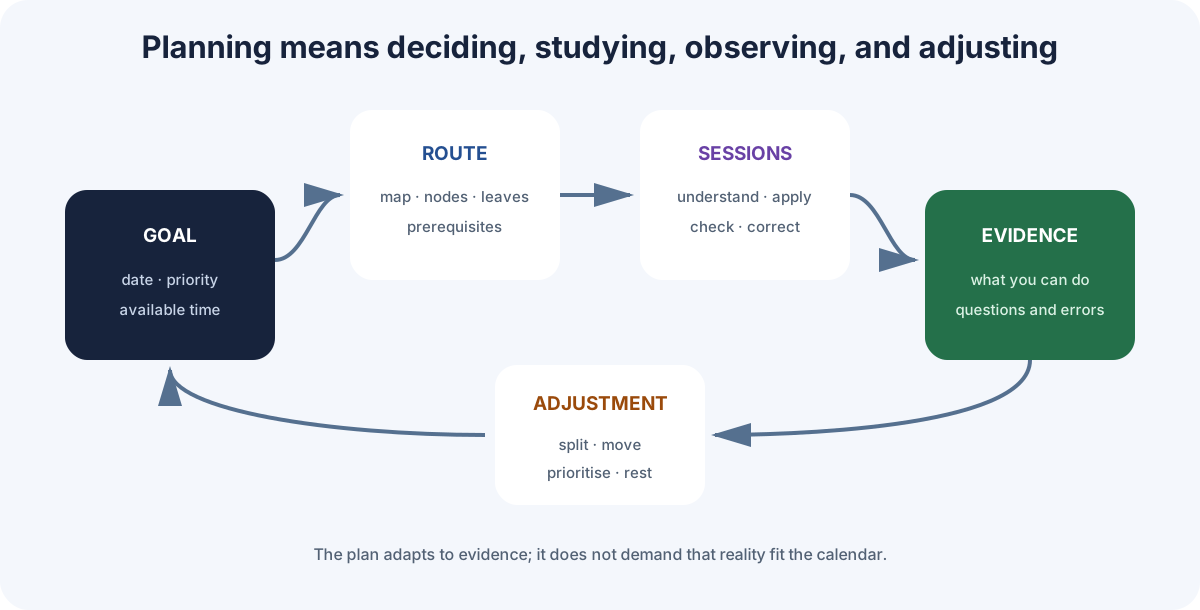
Track and adjust the plan
The plan is a hypothesis about how much work you need. Review it with evidence and modify it without treating every delay as failure.
Minimum record
After each session, note:
- planned goal and completed work;
- approximate time;
- level of support you needed;
- main difficulty;
- one specific next action.
You do not need to measure every minute. Look for patterns that support decisions.
Weekly review
- Which goals advanced, and what evidence shows it?
- Which block consumed more time than expected?
- Did the blockage come from a prerequisite, insufficient practice, or poor organization?
- Which content should remain, move, or be divided?
- Should the workload be reduced to protect rest and continuity?
Adjust without rebuilding everything
- split tasks that are too large;
- increase frequency before using extreme duration;
- change resource if the current one does not address the difficulty;
- introduce spaced retrieval;
- reserve specific time for recurring errors;
- remove tasks that no longer support the goal.
If several weeks produce the same blockage, review the goal, prerequisite, or method. Persistence does not mean repeating a strategy that does not work.
A good plan is not one followed exactly; it is one that helps you decide what to do today and learns from what happened for the following week.