Smart review
A guide to consolidating concepts, formulas, and methods through retrieval, spacing, and connections.
Recall before rereading
Rereading produces familiarity: the text looks known while it remains visible. Retrieval requires reconstructing the idea without seeing it and reveals what remains available.
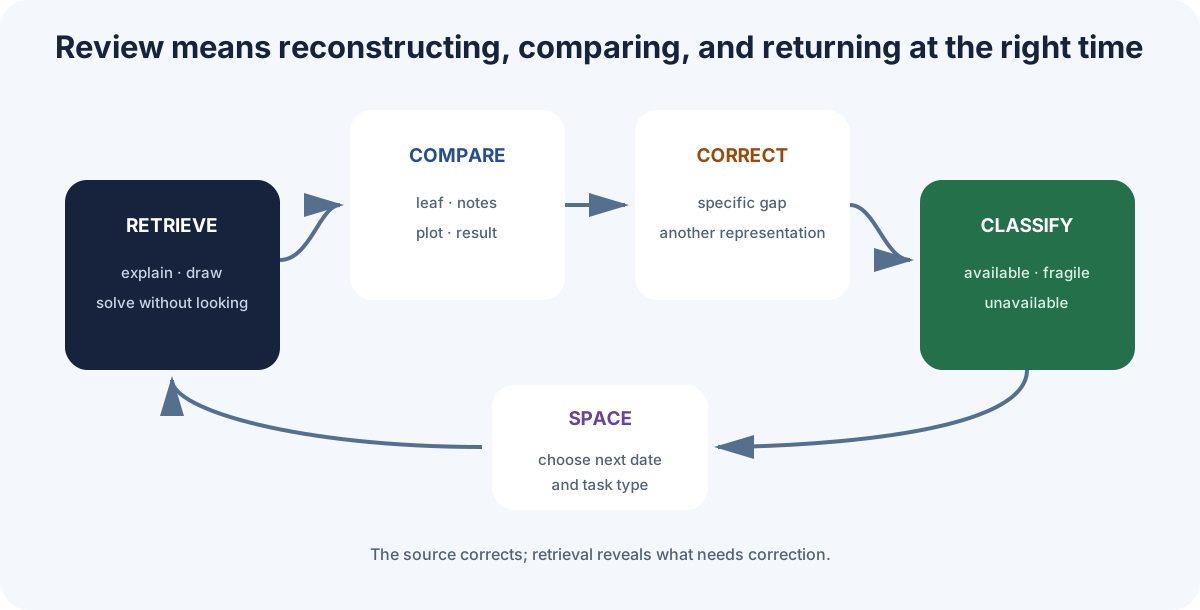
Short sequence
- Close the leaf or your notes.
- Write what the concept means and when it is used.
- Reconstruct the main relation or diagram.
- Add an example, a validity condition, and a frequent mistake.
- Open the source and compare.
- Correct using another color or a separate note.
Do not try to reproduce exact sentences. Retrieve structure, relations, and decisions.
Use gradual cues
If you cannot remember, do not immediately open the entire explanation. Try in this order:
- leaf title;
- tab names;
- one keyword or drawing;
- formula without explanation;
- complete section.
Record which cue you needed. Recalling with a small prompt differs from being unable to reconstruct anything and helps schedule the next review.
Moderate difficulty is useful; remaining stuck for a long time is not. Compare, understand the gap, and try again later.
Space the review
Reviewing several times in one session improves immediate fluency, but distributing encounters requires retrieval after some forgetting.
Flexible schedule
As a starting point, review:
- shortly after the first study;
- one or several days later;
- the following week;
- then at increasing intervals.
There is no universal sequence. Shorten the interval if you needed too many cues or the content is urgent and important. Lengthen it if you recalled accurately and could apply it.
What “review” means
A spaced encounter can be brief:
- explain the concept in one minute;
- draw the diagram;
- choose a model for a case;
- solve one critical step;
- interpret a plot;
- revisit an earlier error.
You do not need to reread the entire leaf each time. Open only the tab that addresses a specific gap.
Distribute problems too
Repeat the same type with variations and, later, without being told which method applies. Temporal separation should change the context enough that you must recognize the strategy rather than continue a recent routine.
Mix and connect content
Practising twenty identical problems trains a routine. Mixing problems requires deciding which principle, representation, or tool applies.
Gradual interleaving
- First learn the basic structure of each type.
- Combine two types that might be confused.
- Explain why you choose a method before solving.
- Add problems with different information or context.
- Include some older content in new sessions.
Do not mix so much at the beginning that every attempt becomes a guess. Difficulty should require discrimination without removing the opportunity to understand.
Build connections
For each leaf, connect:
- one prerequisite;
- a verbal, mathematical, and graphical representation;
- one application;
- one check;
- one limitation;
- a neighboring concept with which it may be confused.
Compare instead of accumulating
A short table comparing two ideas is often more useful than two separate summaries. Compare the question they answer, assumptions, equation, units, plot, and error signal.
Use the Phyxio map to move between the node, related leaves, and prerequisites. The hierarchy organizes the content; your connections explain how to use it.
What is worth reviewing
An isolated formula is forgotten or applied outside its context. Review each item as a small system of meaning.
Concepts
You should be able to answer:
- which quantity or phenomenon it describes;
- which system and reference it uses;
- which variables it depends on;
- which mechanism or principle explains it;
- which neighboring concept it may be confused with.
Formulas
For an important relation, reconstruct:
- the meaning of every symbol;
- unit and dimension;
- assumptions and domain;
- trend as variables change;
- limiting cases;
- how to rearrange for different quantities.
Do not memorize an entire derivation when the goal is to understand its logic, but identify its starting point, key decision, and result.
Plots and diagrams
Review what the axes, slope, area, sign, curvature, and limits represent. Try to draw the qualitative shape first, then consult the Coord, SVG, or DCL graphic available in the leaf.
Procedures
Summarize decisions, not a blind list of operations: how to choose the system, model, equation, tool, and check. Practise recognizing when the procedure does not apply.
A complete review alternates language, equations, drawings, and examples so that no representation remains isolated.
Review with Phyxio
Use each platform element with a specific intention.
Before opening the content
From a favorite or your personal room, identify the leaf and write what you remember about its tabs. Then open only the section needed for comparison.
Leaf resources
- Tabs: retrieve their structure and use one as a correction source.
- Plots: predict their shape first, then read the interpretation.
- Calculator: estimate first and check the input and result.
- Experiment mode: predict how the output will change when one variable changes.
- Simulation: state which model it explores and what you will observe.
- Guided solution: attempt the next step before revealing it.
A leaf may contain Coord, SVG, or DCL graphics, a combination, or none. Choose another representation—your own drawing, a table, or an explanation—when the context includes no graphic.
Phyxio AI
Ask it to:
- pose an explanation question rather than a memory-only prompt;
- compare your answer with a definition;
- change the conditions of a problem;
- identify a hidden assumption;
- critique an interpretation or solution plan.
Answer before reading its proposal and verify it against the leaf. Phyxio AI—also represented by the mascot Phyxi—supports comparison; it does not replace retrieval or decide what you know.
Save only notes or resources that support the next encounter in your room, and label the reason for review.
Decide the next review
Do not schedule every item at the same interval. Use what happened during retrieval.
Three possible outcomes
- Available: you recalled the structure, applied it, and explained its limits. Increase the interval.
- Fragile: you recalled with cues or made a localized error. Keep a moderate interval and revisit that point.
- Unavailable: you could not reconstruct the idea or chose the wrong model. Return soon to the foundation and complete a simple application.
These categories organize review; they are not a grade or an in-leaf self-assessment.
Record little but useful information
Note:
- date;
- specific content;
- cue required;
- error or question;
- approximate next encounter;
- type of next task.
Example: “Elastic potential energy · forgot the reference · review on Thursday using a two-position case.”
Avoid two extremes
Do not repeatedly review comfortable content to feel progress, and do not abandon difficult material for weeks. Alternate consolidated, fragile, and new content.
If an item fails repeatedly, do not shorten the interval indefinitely. Check whether understanding, a prerequisite, varied examples, or another representation is missing.
The goal of spacing is not to keep everything equally fresh, but to retrieve what is needed when a problem requires it.