Set-up and equations
A guide to choosing principles, stating assumptions, and building a symbolic solution without gaps.
From diagram to physical principle
Do not begin by asking, "Which formula contains the unknown?" Ask which principle governs the change represented in the sketch.
| Problem feature | Principle to consider |
|---|---|
| Forces and acceleration | Newton's laws |
| Initial and final states with transfers | Energy and work |
| Brief interaction or collision | Impulse and momentum |
| Equilibrium | Force and torque balance |
| Flow, accumulation, or isolated system | Appropriate conservation law |
| Oscillation, wave, or field | Model equation and associated conditions |
The same problem may admit several approaches. Prefer the principle that directly connects known states to the unknown and requires fewer unknown auxiliary quantities.
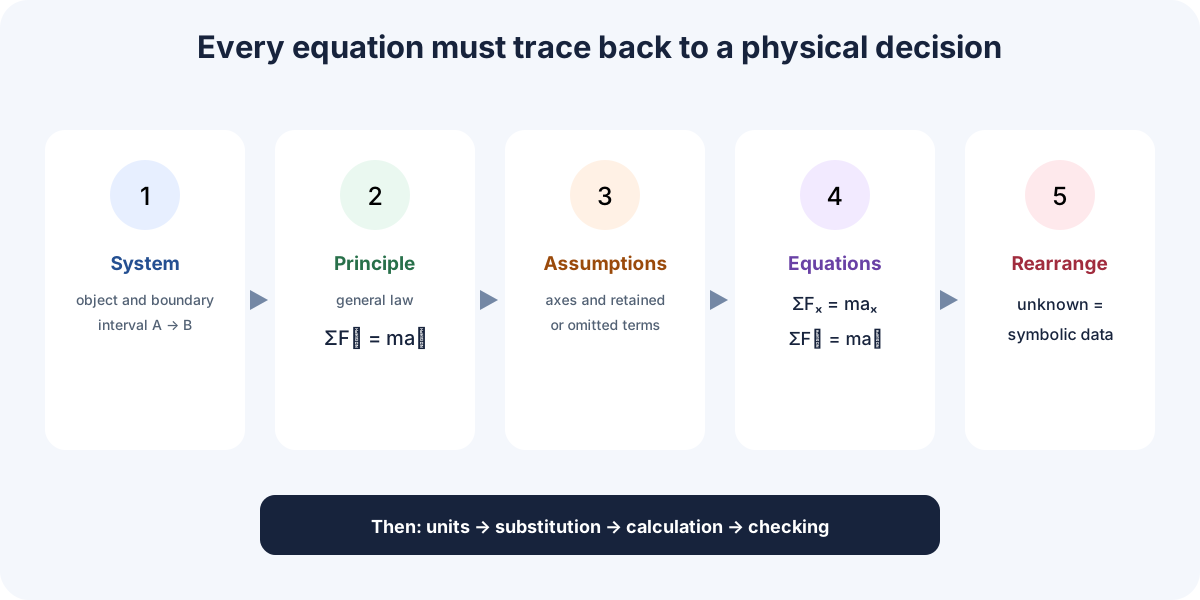
First state the principle in words: "I apply energy conservation to the block-Earth system between A and B." This sentence fixes the system, law, and interval before symbols are used.
State assumptions and choose the model
An equation is valid under particular conditions. Record the assumptions that reduce the general principle to a usable form.
Four kinds of decisions
- System: what lies inside the boundary.
- Interactions: which ones are included and which are neglected.
- Geometry: particle, rigid body, symmetry, or dimensionality.
- Regime: constant, steady, non-relativistic, small oscillations, or another regime.
Write them so they can be checked
Instead of "ideal case", state what it means: "I neglect friction because the statement specifies a smooth surface." Instead of "low speed", say relative to which scale it is low.
Do not confuse an assumption with a conclusion. You cannot impose constant velocity merely to simplify a problem whose purpose is to determine whether the body accelerates.
Every term removed from an equation must be justified by the system, a condition, or a stated approximation.
Build the equation system
Begin with the general form of the principle and specialize it for the chosen system and axes.
- Write the general law, for example .
- Project by direction: , .
- Replace each term with the interactions or relations shown in the diagram.
- Add geometric, constitutive, or kinematic constraints.
- Count independent equations and unknowns.
One equation per relation, not per datum
Having many data does not guarantee that the system is determined. You need as many independent relations as relevant unknowns. Two equivalent equations written differently add no information.
Preserve traceability
Name or number equations and preserve the meaning of every symbol. Define any auxiliary variable you introduce. This lets you locate the first incorrect step without rebuilding the entire solution.
Solve with symbols first
Rearranging before substituting separates physical reasoning from arithmetic and makes dependencies between quantities easier to check.
Procedure
- Decide which unknown to isolate.
- Simplify while preserving equality at every operation.
- Substitute auxiliary equations explicitly.
- Factor or cancel only genuinely common quantities.
- Stop with a symbolic expression for the unknown.
What the final expression reveals
Before entering values, check:
- expected dimensions;
- sign under the chosen convention;
- direct or inverse proportionality;
- behavior when a parameter vanishes or increases;
- possible zero denominators or restricted domains.
If an algebra tool produces the rearrangement, still review its transformations and discarded solutions. Formal manipulation may introduce branches outside the physical domain.
Substitute values and calculate
Substitution is the final part of the set-up, not the first.
- Convert data to compatible units.
- Write one complete substitution line, including parentheses and units.
- Calculate while retaining extra digits in intermediate steps.
- Round only once at the end according to data precision.
- Report value, unit, sign, and reference.
Avoid input errors
- Put negative numbers and complete denominators in parentheses.
- Separate the coefficient from the power of ten.
- Check degrees or radians before using trigonometric functions.
- Do not omit units from the written substitution even if the calculator accepts numbers only.
The global calculator handles arithmetic; a leaf calculator may provide an operational equation and steps. Neither independently validates your system, assumptions, or chosen equation.
Multi-stage problems
When the model, interaction, or condition changes, divide the solution into intervals.
Continuity table
| Stage | System and model | Initial state | Final state |
|---|---|---|---|
| 1 | … | A | B |
| 2 | … | B | C |
| 3 | … | C | D |
The final state of one stage often supplies the initial conditions for the next. State which quantities are continuous and which may change abruptly during an interaction.
Do not use one equation outside its interval
An object may accelerate, collide, and then oscillate. Each phase may require a different principle. For each one, record:
- interval and boundary event;
- chosen system;
- active assumptions;
- its own equations;
- variables connecting to the next stage.
At the end, perform a global check: shared states must agree and the result must answer the instant or stage requested by the statement.