Limiting cases
A guide to testing extremes, simplifications, and transitions to check result consistency.
What a limiting case is
A limiting case studies what an expression predicts when one variable vanishes, becomes very large, equals another, or approaches a meaningful boundary.
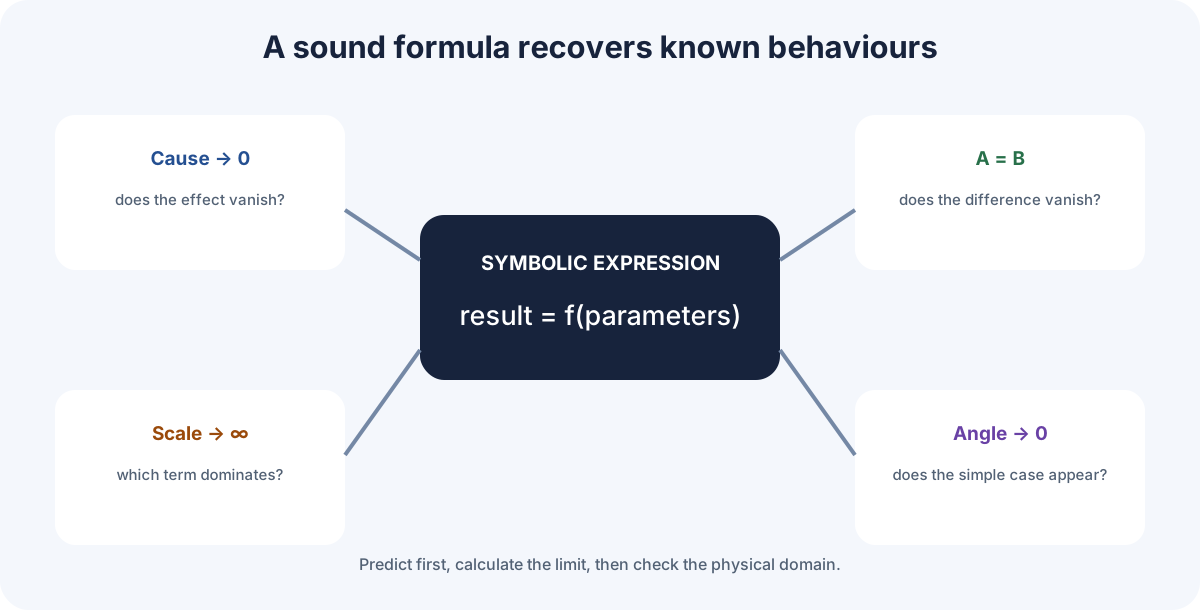
It does not always require a formal mathematical limit. It is often enough to ask:
- what happens if this interaction disappears;
- what remains when two states become equal;
- how the result behaves when one scale dominates the others;
- whether it recovers a known law in a simpler regime.
Why it is powerful
A formula may have correct dimensions and a reasonable scale while predicting a larger effect when its cause disappears. A limit checks structure and trend, not just the calculated value.
A useful limiting case has a qualitatively known answer before it is substituted into the expression.
Choose informative limits
Do not test extremes at random. Connect each limit to an assumption or mechanism in the model.
| Change | Physical question |
|---|---|
| Parameter | Does a property or interaction disappear? |
| Parameter | Does it become dominant, rigid, or insensitive? |
| Two values become equal | Does a difference or flow vanish? |
| Angle | Is a simple geometry recovered? |
| Friction | Is the conservative model recovered? |
| Time or | Does the initial or steady state appear? |
Change one variable at a time
Keep other conditions fixed unless the limit's definition relates them. Changing two variables together may produce different answers depending on the path followed.
Choose at least one limit whose answer is known through intuition, symmetry, conservation, or a simpler law.
Apply the limit step by step
- Write the complete symbolic expression.
- State which variable changes and which remain fixed.
- Predict the behavior qualitatively.
- Substitute the extreme value or calculate the limit.
- Simplify before interpreting.
- Compare prediction and result.
Example: parallel resistors
[
]
If , that branch opens and should remain. The expression recovers it after numerator and denominator are divided by .
If , a short circuit appears and . Both limits agree with the circuit.
Do not enter "infinity" into a calculator as though it were a number. Rewrite the expression to identify the dominant term.
Transitions, continuity, and symmetries
Limits also check how two regimes connect.
Expected continuity
If a parameter changes smoothly and no physical transition exists, the result usually varies continuously. An unexpected jump may indicate a piecewise definition, singularity, or algebra error.
Symmetry
- Exchanging two identical objects should not alter a symmetric result.
- Removing an asymmetry should recover the symmetric case.
- Reversing an axis may change signed components but not invariant scalar quantities.
Recover known theories
A more general theory should approximate the earlier one in the appropriate regime: low speeds, weak fields, small amplitudes, or macroscopic scales, depending on the case.
Checking this transition provides stronger evidence than testing one isolated numerical value.
Mathematical limit and physical domain
An expression may admit a mathematical limit that the model cannot physically approach.
Three different questions
- Does the expression's mathematical limit exist?
- Do the assumptions allow that value to be approached?
- Does the resulting state make physical sense?
For example, a non-relativistic approximation cannot be reliably extrapolated to speeds comparable with . A small-oscillation model fails at large amplitude even if its formula still returns numbers.
Using a limit outside the domain
It may reveal structure or divergence in the expression, but must be labeled as mathematical exploration. Do not present it as a prediction of the real system.
A divergence may signal a real phenomenon, an extreme idealization, or simply model failure.
Diagnose with a limiting case
If the expression fails, classify the disagreement before changing it.
| Observed behavior | Possible cause |
|---|---|
| Does not vanish when its cause vanishes | Missing independent term or factor |
| Grows when it should decrease | Variable placed in wrong numerator or denominator |
| Correct unit but absurd limit | Wrong functional structure or sign |
| Diverges at a regular value | Wrong denominator, domain, or simplification |
| Fails to recover a known case | Missing assumption or constant |
| Depends on the path to the limit | Several scales change simultaneously |
Find the first transformation producing the wrong behavior. Do not add a factor merely to force the limit unless the physical principle justifies it.
Passing one limiting case does not prove the expression. Combine it with dimensions, order of magnitude, conservation, and an independent comparison.