Physical meaning
A guide to interpreting a result's sign, direction, trend, conservation, and plausibility.
From a number to physical meaning
A result is not interpreted by merely repeating its value. Explain which quantity it represents, for which system, in which state, and what it reveals about the phenomenon.
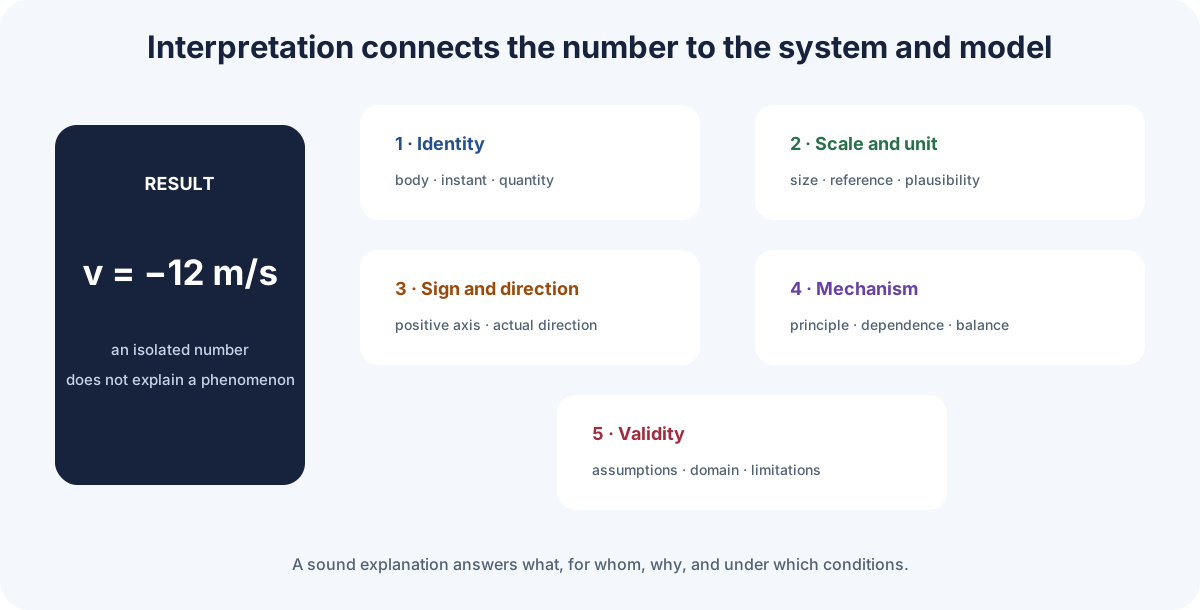
Turn
[
]
into a complete statement: "Relative to the chosen positive axis, the body moves at in the negative direction at that instant."
Five reading layers
- Identity: quantity, system, and instant.
- Unit and scale: size and comparison.
- Sign or direction: reference used.
- Relation: dependence on variables.
- Validity: assumptions and model domain.
Interpretation should add information that is not evident from the isolated number.
Sign, direction, and reference
A sign belongs to a definition or convention. Before judging it, recover the chosen axis, origin, flow direction, or difference.
| Negative result | Possible interpretation |
|---|---|
| Position or velocity | Side or direction opposite to the positive axis |
| Acceleration | Component opposite to the axis, not necessarily slowing down |
| Work | Transfer that reduces energy of the chosen system |
| Power | Energy flow opposite to the defined direction |
| Charge or potential | Property or difference relative to a reference |
| Change | Final value below the initial value |
Magnitude and component
Speed, distance, mass, and kinetic energy do not normally admit negative values under their usual definitions. A vector component does. Check whether you calculated a magnitude, component, or change.
Do not remove a sign with an absolute value unless the question explicitly asks for the magnitude.
Trend, dependence, and causality
An expression should explain how the result changes when one variable changes.
Read the dependence
- direct proportionality: doubling one variable doubles the effect when others remain fixed;
- inverse proportionality: increasing it reduces the result;
- quadratic dependence: the change is amplified and the variable's sign is lost;
- saturation or asymptote: further increases produce progressively less change;
- threshold: behavior changes after a value is crossed.
Hold other variables fixed
Do not attribute change to one variable if others changed as well. In a graph or simulation, use Experiment mode to change one control and read the associated interpretation.
Correlation does not imply causation
Two quantities increasing together does not prove that one causes the other. They may depend on a third variable or be connected by a constraint. Causality comes from the model, experimental design, and physical mechanism, not only from a curve's shape.
Balances and conservation
A conserved quantity does not necessarily remain constant inside every object; it depends on the system and exchanges across its boundary.
Balance structure
[ \text{change in system}=\text{input}-\text{output}+\text{internal production}. ]
For a quantity that is neither created nor destroyed, net production is zero, but transfer with the surroundings may still occur.
Consistency questions
- Is the system isolated for the quantity considered?
- Have all external transfers been included?
- Does a loss in one part appear as a gain elsewhere or as transfer to the surroundings?
- Does the sign agree with the defined flow direction?
- Do initial and final states belong to the same system?
"Energy is lost" is usually incomplete. State which form it takes or where it is transferred.
Physical plausibility
A plausible result is simultaneously compatible with its scale, system constraints, and model assumptions.
Checks
- Bounds: probabilities from 0 to 1, efficiencies no greater than 100%, non-negative magnitudes.
- Scale: comparison with known objects, times, or energies.
- Geometry: a distance or radius must fit the described configuration.
- Chronology: the result belongs to the correct interval and event order.
- Regime: speed, amplitude, or field remains where the approximation is valid.
- Stability: a small data variation does not cause an unjustified jump.
Strange does not mean impossible
A surprising result may reveal a real phenomenon. Do not reject it through intuition alone: strengthen the checks with another derivation, data, a validated simulation, or an experiment.
Physical intuition can be trained, but it may also be biased by everyday scales.
Explain the result clearly
A defensible interpretation answers four questions:
- What does the value mean for the system?
- Why does it have that sign, direction, or trend?
- Which mechanism or principle explains it?
- Under which conditions is it valid?
Short template
For [system and state], the result [value and unit] indicates [meaning]. It behaves this way because [principle or mechanism]. It is valid while [assumptions and domain].
Avoid empty explanations
Do not write "it increases because it increases" or merely restate the equation in words. Identify the causal chain or constraint: net force produces acceleration, a gradient drives a flow, or conservation redistributes a quantity.
You may ask Phyxio AI to critique your interpretation by providing the system, equation, data, and result. Then compare its answer with the leaf, dimensions, and model domain.