Interpreting the problem statement
A guide to detecting ambiguity, implicit data, conditions, and misinterpreted questions.
Identify the actual question
Many algebraically correct mistakes answer a different question from the one asked.
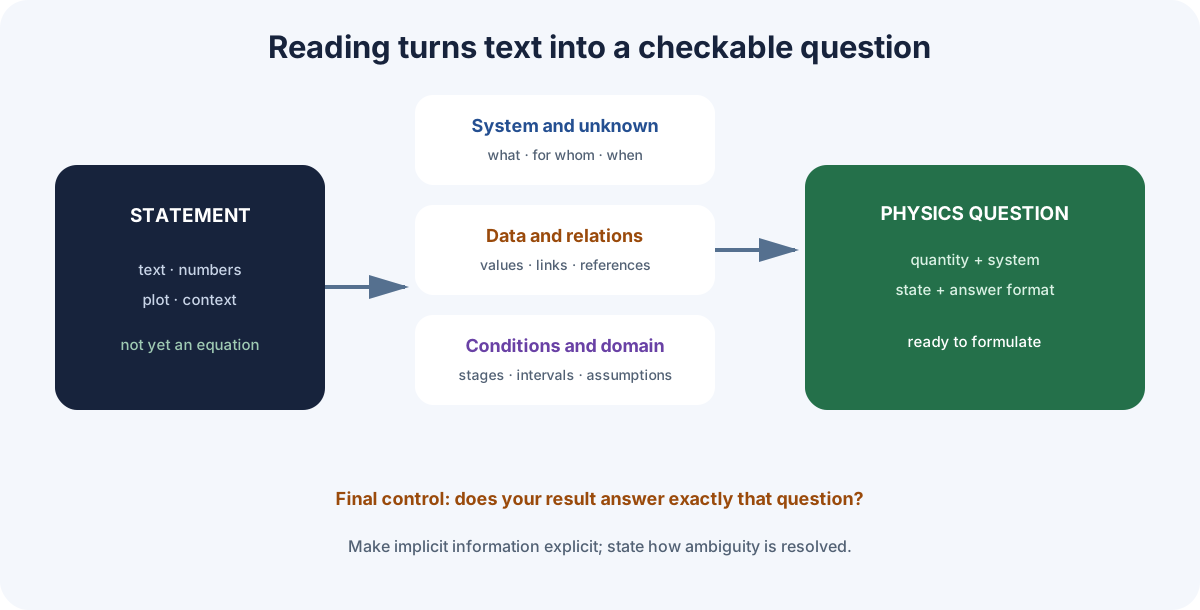
Before calculating, complete this sentence:
I must obtain [quantity] for [system or object], at [time, position, or state], expressed in [unit or form].
Words that change the answer
- magnitude, component, or complete vector;
- average or instantaneous value;
- distance traveled or displacement;
- speed or velocity;
- total, kinetic, potential energy, or a change in energy;
- individual force or net force;
- the time at which something occurs or the duration until it occurs.
Underline the final verb: calculate, prove, estimate, compare, plot, or justify require different outputs.
Do not begin with the formula containing the most data. Begin with the requested quantity and work backwards to the relations you need.
Separate data, relations, and unknowns
Not every number in the text is an input to substitute, and not all information appears as a number.
Useful classification
| Element | Question |
|---|---|
| Explicit datum | What value and unit does the statement provide? |
| Relation | What equality, proportion, or constraint connects variables? |
| Initial or final condition | In what state does the system begin or end? |
| Intermediate unknown | What must I find before the target? |
| Distractor | Is it required by the chosen route? |
| Constant or property | Must it be looked up, or is it assumed known? |
“Takes twice as long,” “starts from the same position,” or “the string remains taut” are relations, not mere descriptions.
Do not force every datum
A problem may include context or allow several routes. If a quantity is absent from your solution, check that its irrelevance is justified; do not add another formula merely to use it.
Label every symbol immediately. Using (m) for two masses or (v) for different states creates errors that look algebraic but begin during translation.
Translate implicit language
Some everyday expressions encode physical conditions. Translate them, but do not add assumptions unsupported by the text.
| Expression | Usual translation that must be checked |
|---|---|
| Starts from rest | |
| Stops momentarily | at that instant, not necessarily |
| Constant velocity | over the interval considered |
| Equilibrium | net force is zero; uniform motion may still exist |
| Frictionless | friction is neglected, not every force |
| Ideal string | negligible mass and no extension, according to the model |
| Rolling without slipping | a relation connects translation and rotation |
| Steady state | macroscopic variables do not change with time |
| Isolated | no relevant exchange of the quantity considered |
Beware of “falls” and “is launched”
“Falls” does not always imply starting from rest. “Is launched” requires a direction and initial velocity. “Height” may be measured from the ground, the launch point, or another stated reference.
Write each translation as a mathematical condition and mark whether it comes from the text, a definition, or your own approximation.
Conditions, intervals, and domain
An equation may produce mathematical solutions that do not belong to the problem. The statement determines which ones are admissible.
Limits to record
- time interval: , before or after an event;
- spatial region: on a track, between two points, or above the ground;
- direction of motion or selected branch;
- contact, tension, slipping, or loss of support;
- range in which an approximation is valid;
- initial, boundary, or continuity condition;
- geometric constraints and physically nonnegative values.
A root may be correct for the equation yet fail to answer a requested future event. A negative height may show that the model continued beyond impact.
Events and stages
Words such as “until,” “from,” “just before,” “immediately after,” or “for the first time” separate states or select a particular solution. If the phenomenon changes regime, divide the problem into stages and transfer conditions correctly between them.
Do not use a formula valid in one stage for the whole process without showing that its assumptions remain active.
Frequent reading traps
| Hasty reading | Consequence | Corrective question |
|---|---|---|
| Linking every number to a formula | Irrelevant information is used. | Which relation actually connects to the unknown? |
| Confusing “increases by” and “increases to” | Change and final value are mixed. | Is this an increment or a final state? |
| Reading an ambiguous multiplier | The factor is interpreted inconsistently. | Does it mean twice as large or a 200% increase? |
| Reading a plot without its axes | The wrong quantity is assigned. | What does each axis and its slope represent? |
| Assuming a diagram is to scale | Angles or lengths are invented. | Is the value stated or merely illustrated? |
| Using unauthorised standard values | The model is altered. | Is the constant given, looked up, or approximated? |
| Ignoring “relative to” | The reference frame changes. | Who observes, or what value is the reference? |
| Solving for the first object mentioned | The answer refers to the wrong system. | Which object owns the unknown? |
If a sentence allows two reasonable readings, state the interpretation you adopt. In assessed work, ask for clarification; if that is impossible, solve under an explicit assumption and mention the alternative.
Do not automatically assume deliberate trickery: a statement may be incomplete or poorly written. Detecting that is also part of rigorous problem solving.
Control rereading
After solving, return to the text without looking first at your operations.
Final check
- Read only the final question and formulate the answer in words.
- Confirm that the calculated symbol belongs to the requested object and state.
- Check whether it asked for a magnitude, component, instant, interval, comparison, or explanation.
- Review the implicit conditions you used and where they entered.
- Confirm that every algebraic solution respects the domain and stages.
- Check the requested unit, precision, and format.
- Write a final sentence connecting number and meaning.
Reconstruction test
Give another person—or Phyxio AI—only your list of data, conditions, and unknown. If they cannot reconstruct the same physics question, information is missing or an interpretation remains hidden. Include the original statement when asking Phyxio AI to critique your reading, and verify each inference it makes.
Reading the statement prepares the solution; this rereading checks that the solution returned to the correct statement. A correctly calculated result aimed at another question is still incorrect.