Assumptions and model
A guide to stating assumptions, choosing the appropriate model, and respecting its domain of validity.
From the real system to the result
A formula does not describe the whole of reality. It describes a model built by selecting variables, boundaries, interactions, and approximations.
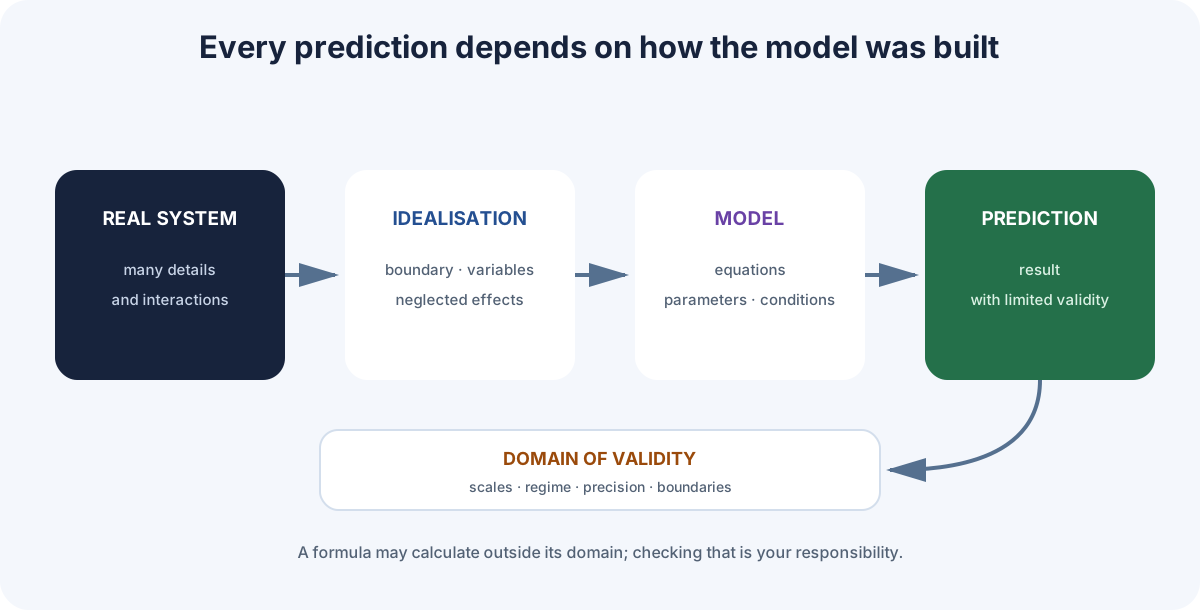
Four distinct levels
- Real system: contains every detail of the phenomenon.
- Idealization: decides which objects and properties are represented.
- Mathematical model: relates variables under specific assumptions.
- Prediction: a result valid while the model's conditions hold.
Treating a body as a particle, a string as ideal, or air as negligible does not claim those properties are exactly true. It claims their effects are considered small for the present question and precision.
Calculation error and model error
A calculation may be flawless yet its prediction unsuitable if the model does not represent the real regime. You must therefore check both the operations and the decisions made before the first equation is written.
State and justify assumptions
A useful assumption must be explicit, relevant, and checkable.
Template
We assume [condition] because [scale, datum, or property], so we may use [simplification] while [validity criterion].
Example: “We neglect air resistance because the distance and speed are small, so we use constant acceleration while drag remains much smaller than weight.”
Frequent types
- point, rigid, or continuous object;
- negligible interaction;
- constant parameter;
- quasistatic, steady, or adiabatic process;
- uniform field;
- small oscillations or small angles;
- nonrelativistic speeds;
- system isolated with respect to a quantity;
- independent measurements or random errors.
Do not write “we use the usual assumptions.” Name the property and its mathematical consequence. Do not turn algebraic convenience into a physical assumption without estimating whether the discarded term is small.
Separate what the statement gives, what the standard model defines, and what you add yourself.
Choose the appropriate model
Do not choose a formula from superficial resemblance. Choose a model whose variables, interactions, and regime match the problem.
Selection questions
- What is the system and where is its boundary?
- Which quantity must be explained or predicted?
- Which interactions dominate and which might be neglected?
- Which length, time, speed, or energy scales are involved?
- Is the process static, transient, periodic, or steady?
- What precision is required?
Several models may be valid
A projectile may be studied without air, with linear drag, or with quadratic drag. A spring may be linear for small deformations and nonlinear beyond that range. The most complex model is not automatically better: it requires parameters and data capable of supporting it.
Choose the simplest model that retains the effects relevant to the question. Then state which phenomena lie outside it.
If two models seem possible, first estimate a dimensionless parameter or compare the size of the competing terms.
Domain of validity
The domain of validity is the set of conditions under which a model's approximations and relations provide the required precision.
Express it as a criterion
Whenever possible, replace vague labels with comparisons:
- small angle: in radians;
- nonrelativistic regime: ;
- point object: characteristic size much smaller than the motion scale;
- uniform field: small spatial variation across the occupied region;
- negligible friction: friction force much smaller than the dominant forces;
- steady approximation: observation time much longer than the transient.
“Much smaller” depends on tolerance. An approximation sufficient for estimation may be inadequate for instrument calibration.
Domain boundaries
Check initial conditions, intervals, singularities, phase changes, loss of contact, saturation, and thresholds. A formula may continue returning numbers outside its domain without warning.
If you extrapolate, label the result as exploratory and explain which assumption may fail first.
Signals of an unsuitable model
| Signal | Possible cause |
|---|---|
| Patterned residuals | A dependency is missing or the functional form is wrong. |
| A parameter changes between trials | It is not constant or absorbs an omitted effect. |
| Failure only at extremes | An approximation has reached its limit. |
| Impossible predictions | A bound, conservation law, or domain has been violated. |
| Requires conditions not supplied | The problem is incomplete or the model has too many degrees of freedom. |
| Works at one scale but not another | A scale-dependent mechanism is missing. |
| Fit improves with complexity without more explanation | Possible overfitting. |
| Small changes cause unjustified jumps | Nearness to a singularity or an ill-conditioned model. |
Do not patch symptoms blindly
Adding constants, changing signs, or removing data until it “works” can hide the problem. State which mechanism is missing and what new prediction would test it.
An outlier may be an error, a regime transition, or a real phenomenon. Document its origin before excluding it.
A model agreeing with one dataset does not prove that its assumptions are true. Seek tests outside the data used to fit it.
A method for reviewing a model
Before calculating
- Delimit the system, boundary, and surroundings.
- List the relevant interactions and scales.
- State each assumption and its mathematical consequence.
- Choose the model and write its expected domain.
After calculating
- Check that the result remains inside the domain.
- Test dimensions, order of magnitude, limiting cases, and conservation.
- Compare with data, references, or an alternative model.
- State which omitted effect would dominate the error.
With plots and simulations
In Experiment mode, vary a parameter towards the boundary of an approximation and read the plot interpretation. A simulation validates only consequences of the implemented model; it does not prove that the model describes the real system.
You can ask Phyxio AI to list hidden assumptions or compare two models. Provide the system, conditions, and required precision, then verify every suggestion against the relevant leaf or a reliable source.
Recommended closing statement
Under [assumptions], we use [model] in the [domain] regime. The result is valid at the required precision; the main omitted effect would be [limitation].