Physical constants
A guide to finding, reading, and using physical constants with appropriate units and precision.
Find a physical constant
Open Constants from global tools. The page gathers reference values and lets you filter them by category.
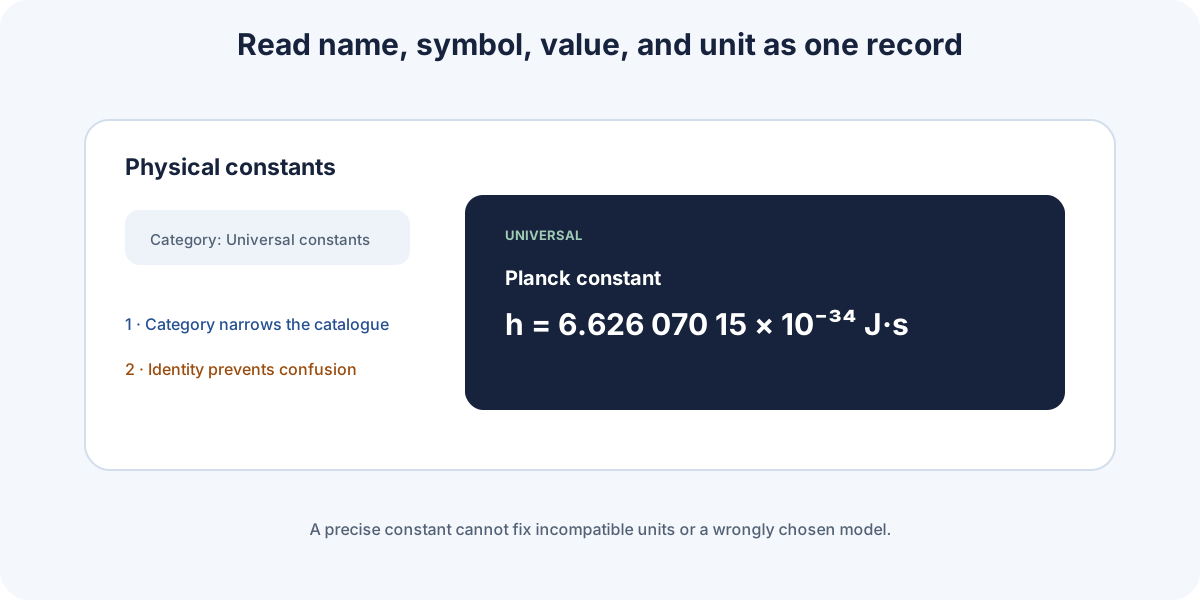
- Choose All to explore the catalog or a category to narrow it down.
- Locate the constant by name and confirm its area: universal, Earth, electromagnetic, thermodynamic, acoustic, mechanics, or optics.
- Read its symbol, value, and unit together.
- Check that it is the constant required by the equation, not another quantity with a similar symbol.
The tool is a reference: it does not automatically insert the value into every calculator or decide whether it should be treated as constant in your model.
Read a constant correctly
A constant should be read as a complete record:
| Element | Purpose |
|---|---|
| Name | Identifies the reference quantity. |
| Symbol | Connects it to the equation; it may vary across sources. |
| Value | Provides the displayed numerical approximation. |
| SI unit | Determines its dimension and compatibility with other data. |
| Category | Helps distinguish constants with similar names or symbols. |
Constant does not mean dimensionless
Many constants have units and dimensions. Omitting them can conceal an incorrect setup. For example, the universal gravitational constant and gravitational acceleration are not the same quantity and do not use the same units.
Keep the symbol while rearranging and substitute its numerical value at the end; this makes the equation's structure easier to review.
Use a constant in a calculation
- Identify the exact constant appearing in the equation.
- Record its value with its unit.
- Convert the remaining data to compatible units, preferably SI.
- Rearrange symbolically before substituting.
- Calculate while retaining enough digits.
- Check dimensions and order of magnitude.
Universal constant, parameter, or approximation
Not every value held fixed during an exercise is a universal constant. An object's mass, an experiment's temperature, or a material coefficient may remain fixed while still being model parameters.
Do not confuse a constant with a local approximation either. For example, using a fixed near Earth's surface is suitable for many problems, but its effective value depends on location and on the required model.
Precision, source, and validity
The tool displays reference values in SI units at a precision intended for educational use. Not every digit belongs in the final result.
How many digits to use
- Retain several digits during intermediate operations.
- Round only once, at the end.
- Do not report more precision than the measured data support.
- For high-precision work, verify the current official source and edition before citing the value.
Exact and measured values
Some SI constants have exactly defined values; others are measured and updated as evidence improves. Material or Earth-condition constants may also depend on temperature, pressure, composition, or location.
A highly precise reference does not improve a result limited by imprecise experimental data or an approximate model.