Dot product
Measure alignment, projection, work, and parallel components. Theory, formulas, worked examples and interactive graphs.
What it is
The dot product combines two vectors and returns a number. It measures how much one vector is aligned with another. If they point in the same direction it is positive, if perpendicular it is zero, and if opposed it is negative.
Why it appears in physics
It appears in mechanical work, projections, power, flux, and angles between directions. It answers how much of a force acts along a displacement or which component of a field crosses a surface.
Visual or geometric idea
The visual image is a shadow. Project one vector onto the direction of the other and multiply by the relevant magnitude. Only the aligned part contributes; the perpendicular part contributes nothing to the dot product.
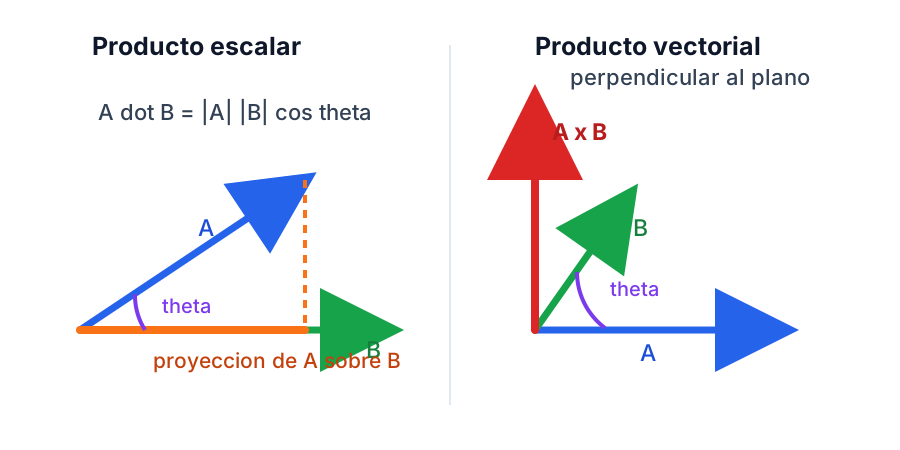
Minimal symbolic language
It is written vec A dot vec B = A B cos(theta) or, by components, A_x B_x + A_y B_y + A_z B_z. The result is not a vector: it is a scalar with unit equal to the product of the two vector units.
What the result means
The result means weighted alignment. In work, W = vec F dot vec d measures energy transferred by the part of force parallel to displacement. If it is negative, the force opposes motion.
When not to use it
Do not use the dot product when you need a perpendicular direction or rotation. Do not forget the angle between vectors: using only magnitudes assumes perfect alignment.
Operational summary
Identify the two vectors, measure angle or components, calculate, and read sign and unit. Basic level: perpendicular gives zero. Intermediate: projections and work. Advanced: alignment criteria in fields and vector spaces.
Procedure
Before calculating
Read the physical situation before operating. Identify whether you need magnitude, direction, component, addition, projection, rotation, change of basis, or field. With vectors, choosing the wrong operation changes the meaning even if the number looks reasonable.
Step 1: identify the mathematical object
Write which vector or vectors appear, which units they have, and relative to which reference they are described. Draw an arrow if geometry is involved. If there are components, declare axes and positive senses before calculating.
Step 2: choose the operation
Choose the tool from the question: addition for resultant, subtraction for comparison, scalar multiplication for magnitude change, dot product for alignment, cross product for rotation, change of basis for new axes, and field for a vector at each point.
Step 3: preserve units and signs
Preserve units in components and results. Magnitude has no sign, but components do. If you change basis, do not mix old and new components. If a product appears, check whether the final unit is a product or quotient.
Step 4: calculate
Calculate step by step. With components, operate axis by axis. With products, decide first whether cosine or sine is needed. With fields, evaluate the point before interpreting the arrow. Check the result with an approximate drawing.
Step 5: interpret the result
Turn the result into a physical sentence: which direction it has, which sense it indicates, which unit it preserves, and which effect it produces. If the result is zero, explain cancellation, perpendicularity, equilibrium, or absence of component.
Self-check checklist
Axes declared, units visible, operation justified, signs checked, drawing coherent, result interpreted, and domain stated. Basic level: arrows. Intermediate level: components. Advanced level: bases, products, and fields with physical meaning.
Guided example
Physical situation
A body receives two vectors related to mechanical work: one points right with magnitude 6 units and another points upward with magnitude 8 units. The question is which vector result describes the combined effect and what physical meaning it has.
Mathematical translation
The vectors are written as components in perpendicular axes: A = (6, 0) and B = (0, 8). The mathematical object is a vector combination in the same basis, not a sum of names or a comparison of isolated magnitudes.
Step-by-step calculation
The resultant is R = A + B = (6, 8). Its magnitude is sqrt(6^2 + 8^2) = 10. The direction forms an angle whose tangent is 8/6, so it points into the first quadrant, between the original two vectors.
Reading the result
The result means the combined effect is not 14 in an arbitrary direction, but an arrow of magnitude 10 with defined direction. If the units were newtons, the resultant is in newtons; if they were meters per second, it is in meters per second.
Common error avoided
The avoided error is adding magnitudes when directions are perpendicular. That sum would only be valid for collinear vectors with the same sense. Here geometry requires components and magnitude reconstruction.
Inverse example
Given result
A resultant vector R = (0, 0) is obtained by adding three forces applied to a point particle, all expressed in the same axes and with the same unit.
What physical question it can answer
It can answer whether the point is in equilibrium after considering those forces. It does not mean no forces exist, but that their vector effects cancel in the chosen basis.
Common errors
Error 1: choosing the wrong operation
It may seem reasonable to use the same calculation for every vector. It fails because addition, projection, and rotation answer different questions. Detect it by reading whether the prompt asks for resultant, component, alignment, or rotation axis. Correct it by choosing the operation before substituting numbers.
Error 2: losing the meaning of the variable
The error appears when an arrow is treated as a number without reference. A force, velocity, or field has different units and meaning. Detect it by asking which physical quantity each vector represents. Correct it by writing physical name, unit, and coordinate system.
Error 3: ignoring units
Vector operations preserve or combine units. A force component remains in newtons, work comes out in joules, and torque in newton meters. Detect it by calculating final units. Correct it by operating with units together with numbers.
Error 4: confusing sign and magnitude
A magnitude cannot be negative, but a component can. Deleting signs destroys direction and sense. Detect it by comparing the sign with the drawing. Correct it by separating magnitude, component, and physical sense.
Error 5: applying a rule outside its domain
Some rules are valid only in orthogonal bases, with vectors in the same system, or in three dimensions. Detect it by checking assumptions about axes, plane, and domain. Correct it by declaring basis, dimension, and limits before operating.
Quick detection rule
If a vector answer does not state direction, sense, unit, and meaning, it is incomplete. The minimum control is drawing the result and checking whether it matches the expected physics.
Physical applications
1. Mechanical work
It appears when a directed quantity must be calculated, compared, or interpreted in mechanical work. A component, resultant, projection, orientation, or associated vector is calculated depending on the question. The result means a physical effect with magnitude, direction, sense, and unit. The dangerous error is reducing it to a number without preserving vector geometry.
2. Projections
It appears when a directed quantity must be calculated, compared, or interpreted in projections. A component, resultant, projection, orientation, or associated vector is calculated depending on the question. The result means a physical effect with magnitude, direction, sense, and unit. The dangerous error is reducing it to a number without preserving vector geometry.
3. Flux
It appears when a directed quantity must be calculated, compared, or interpreted in flux. A component, resultant, projection, orientation, or associated vector is calculated depending on the question. The result means a physical effect with magnitude, direction, sense, and unit. The dangerous error is reducing it to a number without preserving vector geometry.
4. Power
It appears when a directed quantity must be calculated, compared, or interpreted in power. A component, resultant, projection, orientation, or associated vector is calculated depending on the question. The result means a physical effect with magnitude, direction, sense, and unit. The dangerous error is reducing it to a number without preserving vector geometry.
5. Angles between vectors
It appears when a directed quantity must be calculated, compared, or interpreted in angles between vectors. A component, resultant, projection, orientation, or associated vector is calculated depending on the question. The result means a physical effect with magnitude, direction, sense, and unit. The dangerous error is reducing it to a number without preserving vector geometry.
Practice
Level 1: recognition
Identify in five drawings which objects represent vectors, scalars, components, and resultants. Write magnitude, direction, and sense when possible. If reference is missing, state which datum you would request before operating.
Level 2: direct application
Calculate components of a vector (3, 4), its magnitude, and its approximate direction. Then add (3, 4) to (-1, 2) and write the result with symbolic unit.
Level 3: choosing the tool
Decide whether each question asks for addition, subtraction, dot product, cross product, change of basis, or field reading: work of a force, torque, net force, relative velocity, and electric field at a point. Calculate at least one simple example and justify each choice carefully.
Level 4: physical interpretation
Interpret a resultant negative in x and positive in y. Explain its sense and what cannot be concluded from magnitude alone. Connect the answer with force, velocity, or field.
Level 5: intentional error
A learner adds 5 N to the right and 5 N upward and answers 10 N. Locate the error, explain why magnitudes are not added directly, and correct with components, magnitude, and direction.