Final check
A closing guide for checking the answer, units, sign, scale, validity, and presentation.
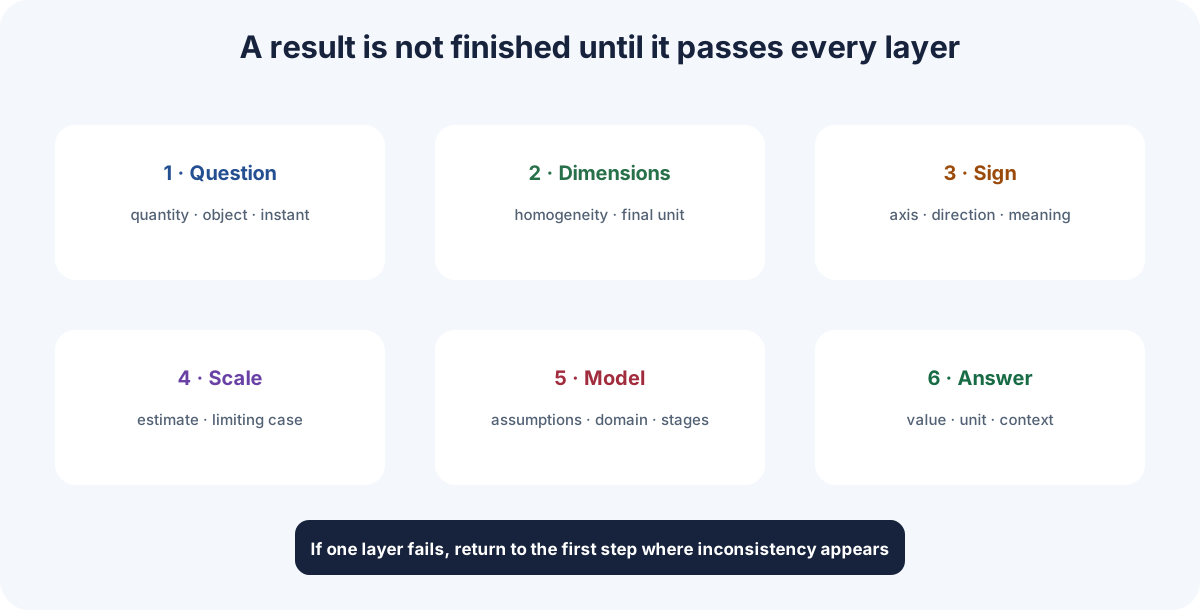
Return to the original question
Before reviewing operations, confirm that the result answers exactly what was asked.
Five opening questions
- Did I calculate the requested quantity rather than an auxiliary one?
- Does it belong to the correct object, system, point, or instant?
- Did I answer every part of the statement?
- Was a numerical, symbolic, vector, or explanatory form requested?
- Do the unit and reference match that quantity?
A flawless calculation may answer a different question. For example, finding speed just before a collision does not give velocity immediately afterwards.
Write a provisional answer sentence: "The block's velocity relative to the ground at is..." If you cannot complete it unambiguously, review the set-up.
Check units and dimensions
The final quantity must have the expected dimension. A velocity cannot be reported in newtons, and energy cannot be added to force.
Quick review
- Check homogeneity in the symbolic equation.
- Reduce compound units until the resulting quantity is recognizable.
- Review prefixes and powers: does not convert like .
- Confirm that angles used degrees or radians as required by the tool.
- Write the unit beside the final value, not only beside the data.
A dimensionally correct equation may still be physically wrong, but a dimensionally inconsistent equation cannot be correct. This test detects faults; it does not prove the solution by itself.
For more depth, use the "Dimensional analysis" leaf in the next node.
Interpret sign and direction
A negative sign does not automatically mean an error. Relate it to the axis, reference, and definition of the quantity.
Interpretation questions
- Does the vector point along or opposite the positive axis?
- Does the sign represent loss, transfer, decrease, or resistive work?
- Is the quantity a non-negative scalar, such as speed or distance?
- Does a square root produce two mathematical solutions while only one satisfies the conditions?
- Does zero represent equilibrium, cancellation, or absence of the effect?
Compare with the qualitative prediction made while reading. If they differ, do not change the sign merely to force agreement: review axes, components, conditions, and the prediction itself.
For a vector answer, give components or magnitude and direction. An isolated number may discard the essential information.
Check scale and limiting cases
Estimate the order of magnitude before or after calculating. A small-factor discrepancy may arise from an approximation; a difference of often indicates a wrong prefix, power, or unit.
Scale test
- Compare with a known quantity of the same kind.
- Round the data to one digit and make a mental estimate.
- Check whether the result fits the described space, time, or energy.
- Confirm that it does not exceed a physical limit applicable to the model.
Limit test
Ask what the expression predicts when one variable vanishes, grows very large, two values become equal, or an interaction disappears. The trend should agree with the physical principle.
A limiting case may also leave the model's domain. Use it to check mathematical structure, but state when it stops representing reality.
Review the model and global consistency
Return to the assumptions and check that the result does not contradict them.
Consistency loop
- If you neglected an interaction, does the result confirm that its effect would be small?
- If you used a small-angle approximation, is the resulting angle within that regime?
- If you assumed non-relativistic behavior, is the calculated speed sufficiently below ?
- If you applied conservation, did you correctly identify external exchanges?
- In several stages, does the final state of one equal the initial state of the next?
Independent check
When possible, use another route: an estimate, an equivalent equation, a graph, or a conservation principle. Two methods are independent only if they do not repeat the same mistaken assumption.
If verification requires changing an assumption, rebuild the model rather than only repeating the final operation.
Present a defensible answer
The final answer should be understandable without reconstructing every operation.
Recommended structure
- Result: value and unit, or symbolic expression.
- Reference: object, instant, axis, or system it belongs to.
- Interpretation: meaning of sign, direction, or trend.
- Conditions: assumptions limiting validity.
- Precision: significant figures consistent with the data.
Example: "With the positive axis upward and air neglected, the ball's velocity immediately before impact is ; the sign denotes downward motion."
Do not report ten decimals when the data justify only three significant figures. Do not write "therefore" without naming the quantity obtained.
This leaf completes the general method. The "Checking results" node then explores dimensional analysis, order of magnitude, limiting cases, and physical meaning in greater depth.